September 7, 2026
When most people hear the name Xoloitzcuintli, they immediately imagine a completely hairless dog.
The hairless Xolo is the image that made the breed famous.
But there is another Xolo.
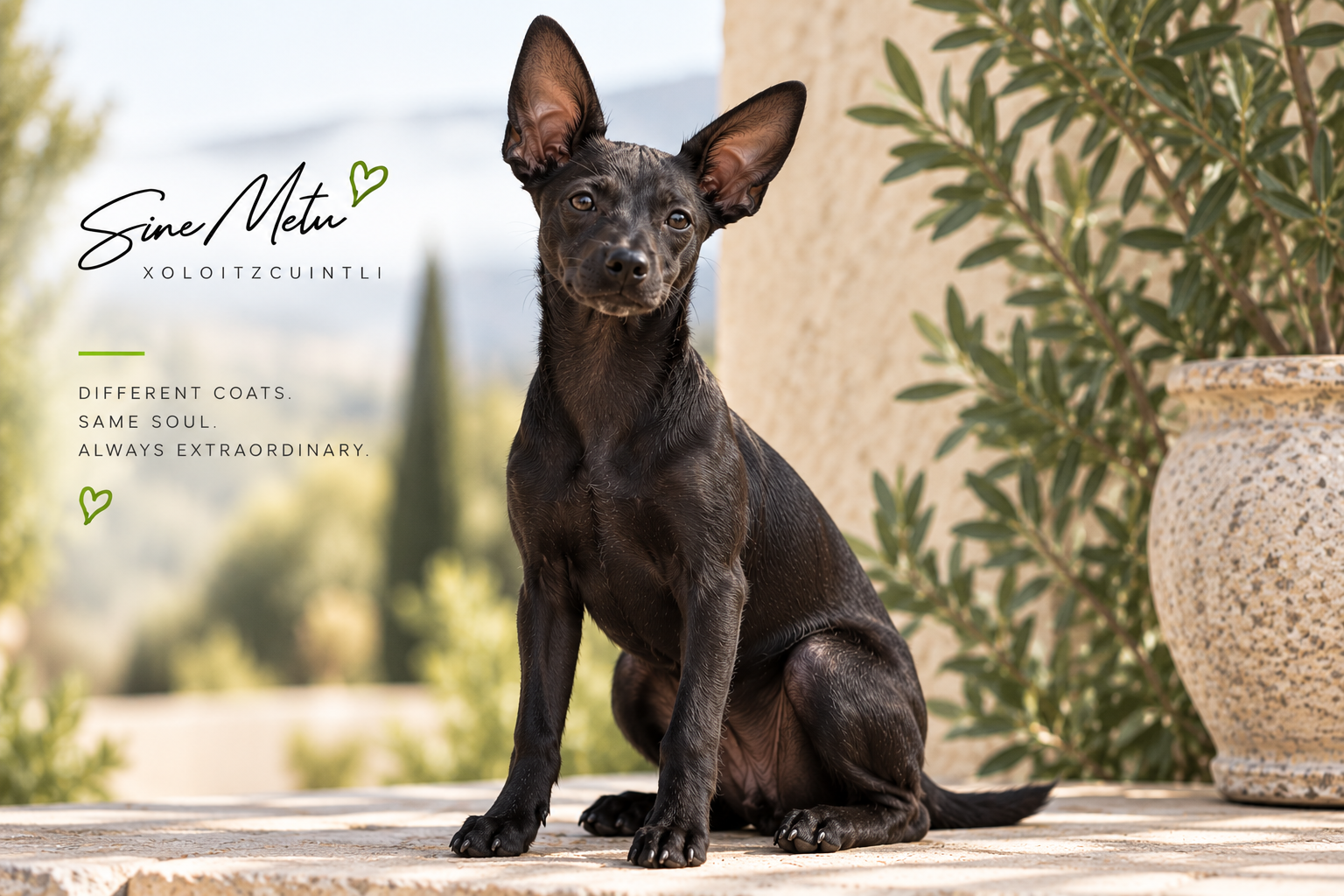
A Xolo with a complete coat.
And although coated Xoloitzcuintli were historically less appreciated simply because the hairless variety became the visual symbol of the breed, modern breeding has made something very clear:
A high-quality coated Xolo can be an extremely valuable breeding dog.
Not because coated dogs are somehow better than hairless dogs.
Not because hairless Xolos are genetically inferior.
But because the genetics of Xolo hairlessness create a unique breeding situation.
The coated Xolo is an essential part of that system.
The breed officially recognizes both hairless and coated varieties. The FCI standard specifically states that well-constructed coated Xoloitzcuintli with excellent type, correct conformation and acceptable coat and colours may be used for breeding to provide genetic diversity. The standard also prohibits coated × coated breeding and requires coated breeding stock to meet specific pedigree and evaluation conditions.
Understanding why this matters requires understanding one gene:
FOXI3.
A coated Xolo is not a different breed.
It is not a mixed dog.
It is not a “failed” hairless puppy.
And it is not simply a Xolo that happened to grow hair.
The coated variety is a naturally occurring genetic expression within the Xoloitzcuintli breed.
Your book makes this distinction very clearly: coated Xolos have the same breed character, temperament and fundamental breed traits as hairless Xolos. They are intelligent, sensitive, devoted dogs that form the same strong relationships with their families.
The FCI standard likewise recognizes Hairless Variety and Coated Variety under the same breed standard. Both belong to the Xoloitzcuintli.
The difference is primarily the coat—and, importantly, the biological consequences associated with the genetic mechanism that produces hairlessness.
That mechanism is fascinating.
The hairlessness of Xoloitzcuintli is associated with a mutation in the FOXI3 gene.
FOXI3 is a transcription factor involved in ectodermal development, including the development of hair and teeth.
In 2008, Drögemüller and colleagues identified a mutation in FOXI3 associated with canine ectodermal dysplasia in Mexican and Peruvian hairless dogs and Chinese Cresteds. The mutation is a 7-base-pair duplication that causes a frameshift and premature stop codon.
Later research confirmed the same FOXI3 variant in the three major dominant-hairless dog breeds.
The mutation does more than affect hair.
It also helps explain why hairless dogs can have differences in dentition.
Research into historical and modern specimens has demonstrated the association between the heterozygous FOXI3 variant and the characteristic dental phenotype of hairless dogs.
This is why the hairless phenotype of the Xolo cannot be understood simply as:
“one gene = no hair.”
It is more complicated.
FOXI3 participates in the development of several ectodermal structures.
The coat is simply the most visible expression.
The easiest way to understand Xolo genetics is to simplify the two relevant versions of the gene.
For illustration:
A hairless Xolo generally carries:
H/h
A coated Xolo carries:
h/h
The crucial point is what happens with:
H/H
Two copies of the hairless-associated variant are not compatible with normal embryonic development.
This is why the hairless phenotype is described as dominant but homozygous lethal.
The American Kennel Club explains the same genetic principle: one copy produces the hairless phenotype, while two copies result in embryonic death.
This is one of the most important facts that every serious Xolo breeder should understand.
The word lethal can sound frightening.
But in this context it does not mean that a living Xolo suddenly becomes sick or dies because it carries the hairless gene.
It means something different.
A puppy that would inherit two copies of the hairless-associated mutation does not develop normally and does not survive embryonic development.
In other words, the problem occurs before birth.
The embryo does not become a living hairless puppy.
This is why you do not normally see a population of adult Xolos carrying two copies of the hairless mutation.
The genetic combination is lost during development.
Earlier genetic mapping work had already demonstrated that canine ectodermal dysplasia in hairless dogs segregated as a dominant trait with homozygous lethality.
This is where the genetics becomes extremely practical.
Imagine:
Hairless H/h × Hairless H/h
Each parent can pass either:
The theoretical combinations are:
HhHH/H — embryonic lethalH/h — hairlesshH/h — hairlessh/h — coated
The expected genetic proportions are:
The exact number of puppies in a real litter will, of course, not follow mathematical percentages perfectly.
Genetics gives us probabilities, not guaranteed litter results.
But the principle is extremely important.
When two hairless Xolos are bred, approximately one quarter of the conceptions are expected to carry the homozygous lethal combination.
This is why the FCI standard specifically discusses the genetic issue and the role of coated dogs in maintaining genetic diversity.
Now consider a different mating:
Hairless H/h × Coated h/h
The hairless parent can contribute:
The coated parent can contribute only:
The possible offspring are:
The theoretical result is:
50% hairless + 50% coated
Most importantly:
There is no H/H combination.
Therefore, this mating does not create the homozygous lethal hairless genotype.
That is the genetic reason why a coated Xolo can be so valuable in a carefully planned breeding program.
This needs to be explained carefully.
It would be incorrect to promise that every coated × hairless mating will produce a larger litter.
Litter size is affected by many factors:
But there is one thing we can say genetically.
With:
Hairless × Hairless
there is an expected 25% homozygous lethal genotype among conceptions.
With:
Hairless × Coated
that combination cannot occur.
Therefore, the coated × hairless mating removes this particular source of expected embryonic loss.
It does not guarantee a large litter.
It means that the lethal hairless/hairless genetic combination is no longer part of the mating.
This distinction is important.
The value of a coated Xolo is not that it magically produces more puppies.
Its value is that it allows the breeder to produce hairless puppies without creating the homozygous hairless combination.
This leads to one of the most interesting paradoxes of the breed.
People often want a litter with as many hairless puppies as possible.
That sounds logical.
But if the breeding population consisted only of hairless Xolos and breeders continually mated hairless × hairless, the genetic system would continually produce the same lethal combination.
The coated Xolo is therefore not an unwanted side product.
It is part of the biological balance created by the hairless mutation.
The coated dog carries the normal version of the FOXI3 locus and can be paired with a hairless dog to produce hairless offspring without the homozygous hairless genotype.
That makes a high-quality coated Xolo potentially very useful.
This is partly a matter of history and breeding culture rather than a universal rule.
The hairless Xolo became the visual symbol of the breed.
People saw the unusual skin, the large ears, the primitive appearance and the ancient Mexican identity.
The coated dog simply looked more like an ordinary dog.
As a result, it was easy for buyers to think:
“Why would I want a coated Xolo when I can have the hairless one?”
This attitude also influenced breeding priorities.
The FCI standard itself documents that hairless × hairless breeding was historically preferred because it produces fewer coated puppies.
But the same standard simultaneously recognizes the importance of coated dogs for genetic diversity.
That distinction is crucial.
The goal is not to eliminate the coated variety.
The goal is to use it intelligently.
A coated Xolo can have:
Your book emphasizes exactly this point: coated Xolos are the same Xoloitzcuintli with a coat, and they can be just as intelligent, devoted and emotionally connected to their people as hairless dogs.
This is particularly important for future owners.
A person who chooses a coated Xolo is not choosing “less Xolo.”
They are choosing a different coat variety of the same breed.
The FOXI3 mutation is associated not only with hairlessness but also with dental differences.
Hairless Xolos may naturally have missing or reduced dentition because the same developmental pathway affects hair and teeth.
Coated Xolos, by contrast, generally have normal dentition.
Research examining historical specimens found clear differences between the dental phenotype associated with the FOXI3 hairless mutation and coated dogs without that mutation.
This makes coated Xolos especially interesting in a breeding program where breeders are also paying attention to dentition.
Your book describes the practical selection goal of choosing hairless breeding dogs with as complete a dentition as possible, using selection to improve this trait while preserving the unique genetics of the breed.
A coated dog brings another genetic combination into the breeding equation.
This is one of the most important points.
The existence of the coated variety does not mean that every coated puppy should automatically become breeding stock.
Quite the opposite.
The coated Xolo used for breeding should be exceptional.
The FCI standard says that coated Xolos used for breeding should have excellent type and conformation, acceptable colours and coat, and meet the pedigree and evaluation requirements of the breed. They may be bred only to hairless Xolos.
In other words:
Coated does not equal breeding quality.
Just as:
Hairless does not automatically equal breeding quality.
The breeder still has to evaluate the entire dog.
A serious breeder should look beyond the coat.
The coated dog should be evaluated for:
Does the dog genuinely look like a Xoloitzcuintli?
Are the proportions, topline, chest, limbs and movement correct?
Does the dog have the characteristic Xolo head, ears and expression?
Is the dog stable, intelligent, balanced and typical for the breed?
Is the dog clinically healthy and suitable for reproduction?
Does the dog have strong, complete dentition?
Is the coat acceptable in texture, length and presentation?
Does the dog come from a well-documented breeding program?
What does this particular dog contribute to the population?
The last question is especially important.
Genetic diversity is not simply about adding an unrelated dog to a pedigree.
It is about maintaining useful genetic variation within a population while continuing to select for the characteristics that define the breed.
A coated Xolo can contribute genetic diversity because it carries the normal allele at the FOXI3 hairlessness locus rather than the hairless-associated mutation.
When bred appropriately to a hairless Xolo, it can return hairless offspring while avoiding the homozygous hairless combination.
The FCI standard explicitly identifies genetic diversity as a reason well-constructed coated Xolos may be used in breeding.
That is a remarkably important statement for such a visually overlooked variety.
At first glance someone might ask:
“If coated dogs have the normal allele, why not breed two coated Xolos together?”
Because that would produce:
h/h × h/h = 100% h/h
In other words:
100% coated puppies.
There would be no hairless offspring from that mating.
This is why the FCI standard does not permit coated × coated breeding.
The purpose of using a coated Xolo in the breeding program is not to create a separate coated population.
It is to combine the normal allele with a hairless parent in a controlled breeding strategy.
The coated dog is therefore a genetic tool within the breed—not a replacement for the hairless variety.
MatingExpected genetic outcomeHomozygous lethal combination?Hairless × Hairless50% hairless, 25% coated, 25% embryonic lethalYesHairless × Coated50% hairless, 50% coatedNoCoated × Coated100% coatedNo
These are theoretical Mendelian expectations, not guarantees for an individual litter.
Real litters can deviate substantially from these percentages.
But the genetic principle remains the same.
Xoloitzcuintli is not a breed with an enormous global breeding population.
Every breeding decision therefore matters.
A breeder who thinks only about producing the maximum possible number of hairless puppies may unintentionally narrow the genetic options available to the next generation.
A breeder who thinks about the whole population asks a different question:
What combination gives us the healthiest, most correct and genetically valuable next generation?
That is a much more sophisticated approach.
And this is where coated Xolos become particularly interesting.
There is an important danger in going too far in the opposite direction.
Once breeders understand the genetic value of coated dogs, it can become tempting to treat every coated Xolo as genetically precious simply because it is coated.
That would also be a mistake.
A coated Xolo should not enter a breeding program solely because it can eliminate the lethal combination.
It still needs to be a good Xolo.
The goal should be:
excellent coated Xolo + excellent hairless Xolo
—not simply:
coated + hairless.
The genetic advantage is only useful when combined with breed quality.
Modern breeding is increasingly moving away from the idea that the breed should be judged only by its most visually recognizable characteristic.
For Xoloitzcuintli, that characteristic is hairlessness.
But the breed is much more than hairless skin.
A Xolo is also:
The coated variety is part of that equation.
This is why FCI does not simply exclude coated dogs from breeding.
Instead, the standard gives them a carefully defined role.
Imagine two breeding programs.
The breeder thinks:
“I want as many hairless puppies as possible.”
The breeding strategy repeatedly uses hairless × hairless combinations.
This can produce a high proportion of hairless puppies among the surviving offspring, but the mating also produces the homozygous lethal combination.
The breeder thinks:
“I want the best possible offspring and I want to manage the genetics of the breed responsibly.”
A high-quality coated dog may be selected as one parent.
The result can include hairless puppies and coated puppies, but the homozygous hairless combination is avoided.
The second approach may produce fewer hairless puppies as a percentage of the surviving litter.
But genetically, it can be extremely valuable.
This is why percentage of hairless puppies should never be the only measure of breeding success.
One of the greatest dangers in breeding a rare breed is thinking too narrowly.
If breeders select only for the most obvious visual trait, the gene pool can gradually become narrower.
Coated Xolos provide another legitimate genetic pathway.
They allow breeders to introduce the normal FOXI3 allele while retaining the possibility of producing hairless offspring.
This does not solve every genetic problem in the breed.
It does not make a breeding automatically healthy.
It does not replace health testing, pedigree analysis or careful selection.
But it gives breeders another option.
And in a rare breed, having more responsible options matters.
There is another side to the story.
A coated Xolo does not have to reproduce in order to be valuable.
Some families genuinely prefer a dog with a coat.
A coated Xolo offers the characteristic temperament and relationship of the breed while having a short, complete coat.
Your book points out that some owners consciously choose coated Xolos precisely because they want the character of a Xolo together with the presence of hair.
This means the coated variety has value as a companion as well.
It is not merely a breeding instrument.
It is a legitimate form of the breed.
The term Powder Puff is commonly associated with the Chinese Crested.
For Xoloitzcuintli, the official terminology is:
Hairless Variety
and
Coated Variety.
That distinction matters when writing about the breed scientifically or for an SEO-focused breed resource.
The coated Xolo has a complete coat, while the hairless Xolo has the characteristic absence of body hair with the breed-specific distribution of remaining hair.
The two are genetically connected through the FOXI3 system.
This may sound surprising.
A beautiful hairless puppy may be easier to sell.
It may attract more attention.
It may be the puppy that people immediately associate with Xoloitzcuintli.
But breeding value is not the same as visual popularity.
A coated Xolo with:
may be enormously valuable to a serious breeder.
Sometimes the dog that attracts the least attention from the public can be one of the most interesting dogs in a breeding program.
That is a fundamental principle of responsible breeding:
Breed for the future, not only for what is most popular today.
The most important thing to understand is simple:
Hairless is dominant.
Coated is the normal recessive state at the hairlessness locus.
Two copies of the hairless-associated mutation are embryonically lethal.
Therefore:
Hairless × Hairless → hairless + coated + expected embryonic loss
while:
Hairless × Coated → hairless + coated, without the homozygous lethal combination.
The coated Xolo therefore has a unique place in the reproductive genetics of the breed.
It is easy to think of breed preservation as preserving appearance.
But true breed preservation is more complicated.
Preservation means maintaining:
The coated Xolo belongs inside that picture.
The FCI standard itself recognizes this by permitting selected coated Xolos to contribute to breeding for genetic diversity.
This is not a loophole.
It is not a compromise.
It is part of responsible management of a breed whose most famous characteristic is controlled by a genetically unusual system.
Perhaps this is the most important message for future owners.
A coated Xolo does not have less Xolo temperament.
It does not have less Xolo intelligence.
It does not have less Xolo loyalty.
It does not have less Xolo character.
It simply has a coat.
And behind that coat is an important genetic story.
Your book describes coated Xolos as fully legitimate members of the breed and emphasizes their role in maintaining healthy genetics and allowing the breed to remain strong and viable.
Modern genetics gives us a scientific explanation for why that role exists.
The coated Xoloitzcuintli teaches us something important about breeding.
The most obvious dog is not always the most genetically interesting dog.
The most popular phenotype is not necessarily the most useful phenotype.
And the puppy that looks different from what the public expects may carry exactly what a rare breed needs.
The coated Xolo is part of the natural genetic architecture of the Xoloitzcuintli.
Without the normal allele at the FOXI3 locus, the breed could not maintain the genetic balance associated with its dominant hairless phenotype.
Without careful breeding, the hairless mutation creates a predictable embryonic cost.
With carefully selected coated Xolos, breeders gain another way to maintain genetic diversity and produce hairless offspring without creating the homozygous lethal combination.
That makes the coated Xolo more than a coat variety.
It makes the coated Xolo part of the genetic future of the breed.
If you are looking for a Xoloitzcuintli puppy, do not automatically reject a coated puppy simply because you originally wanted a hairless dog.
Ask yourself what you actually want from the breed.
If your priority is:
then the presence of a coat does not remove those characteristics.
And if you are considering a puppy for future breeding, the question becomes even more important.
Do not ask only:
“Is this puppy hairless?”
Ask:
“What does this dog contribute to the breed?”
That is the question a serious breeder should be asking.
The Xoloitzcuintli is famous because it can be almost completely hairless.
But the genetic story behind that hairlessness is one of the reasons the coated Xolo is so important.
The hairless dog carries the dominant FOXI3-associated mutation.
The coated dog does not.
Two hairless parents can produce a lethal homozygous combination.
A hairless and a coated parent can produce hairless offspring without that combination.
And this is precisely why the coated Xolo should not be viewed as an undesirable exception.
It is part of the breed's genetic balance.
The future of the Xoloitzcuintli should not be about producing the greatest possible number of hairless puppies.
It should be about producing the best possible Xolos.
Healthy.
Correct.
Balanced.
Genetically valuable.
And capable of carrying this extraordinary breed into the next generation.
Coated Xoloitzcuintli are a legitimate variety of the breed.
The hairless phenotype is associated with a FOXI3 mutation.
Hairless Xolos are generally heterozygous for the hairless-associated mutation.
Two copies of the mutation are embryonically lethal.
Hairless × hairless theoretically produces 25% homozygous lethal, 50% hairless and 25% coated conceptions.
Hairless × coated theoretically produces 50% hairless and 50% coated offspring, with no homozygous hairless combination.
Coated × coated produces coated offspring and does not produce hairless puppies.
The FCI standard allows selected coated Xolos to be used for breeding to support genetic diversity and prohibits coated × coated breeding.
A coated Xolo is not a lesser Xolo.
It is another expression of the same extraordinary breed.

Is a mono-breed Miniature Xolo kennel.
We know everything about the Xolo breeding and even more.
We choose only the best Xolo bloodlines in the world for the breeding purpose in our kennel.
Our graduates live in more than 15 countries in Europe, the USA and Canada.
All our breeding dogs get tested for genetic diseases and are in excellent health condition.


