September 3, 2026
When people first discover the Miniature Xoloitzcuintli, one of the first questions they ask is:
“How much will my Xolo weigh when fully grown?”
The answer is not as simple as giving one number.
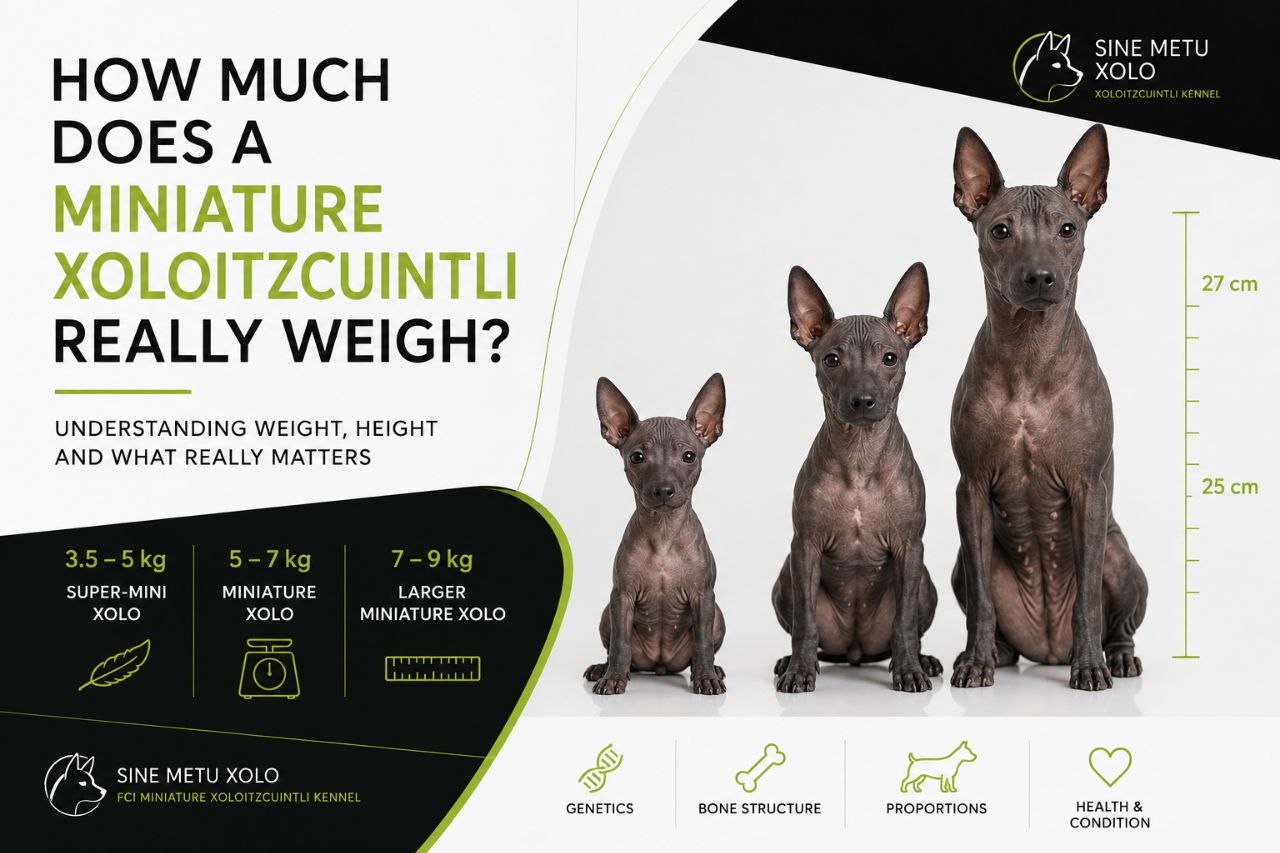
A healthy adult Miniature Xoloitzcuintli can have different body weights depending on its height, bone structure, proportions, muscle mass, sex, and individual genetics.
Height matters more than the number on the scale.
The Miniature Xoloitzcuintli is the smallest size variety of the Xoloitzcuintli.
For an adult dog, the important measurement is height at the withers, not simply body weight.
Two Miniature Xolos can have the same height but different weights and still both have a healthy, correct body structure.For example, a smaller, fine-boned Xolo may weigh around 5 kg, while a larger and more substantial Miniature Xolo may weigh 6–9 kg or more, depending on its height and build.
This is why estimating a puppy's adult weight should never be based on kilograms alone.
Typical adult weight of a Miniature XoloitzcuintliAs a practical guide, we often see approximately:
- Around 5 kg — smaller, lighter Miniature Xolos
- Around 6–7 kg — medium-sized Miniatures
- Around 8–9 kg — larger, stronger Miniatures
These are practical examples, not a breed-standard weight table.
The breed standard focuses primarily on height and correct proportions, rather than requiring every Miniature Xoloitzcuintli to weigh the same.
Why can two Xolos weigh differently?
There are several reasons.
1. Height
A taller Miniature Xolo will naturally tend to weigh more than a shorter one.
2. Bone structure
Some Xolos have a finer bone structure, while others are more substantial.
3. Muscle
A fit, active dog can weigh more than a less muscular dog of the same height.
4. Sex
Males are often more substantial than females, although individual variation is significant.
5. Genetics
Parents and the wider pedigree can give us useful clues about how large a puppy is likely to become.
This is one reason why experienced breeders look at the entire pedigree and the development of previous puppies, rather than trying to predict adult size from one puppy at one particular age.
How much will my Xolo puppy weigh as an adult?
This is one of the most difficult questions to answer precisely.
A puppy's current weight can give us information about its development, but it does not guarantee its final adult weight.
At Sine Metu, when we evaluate a puppy's future size, we look at several things together:
- the puppy's current development;
- parents and relatives;
- bone structure;
- proportions;
- growth pattern;
- sex;
- and the size of dogs in the pedigree.
Even then, an estimate remains an estimate.
A responsible breeder should be honest about this rather than promising an exact adult weight when the puppy is still growing.
Is a heavier Xolo a healthier Xolo?
Not necessarily.
Weight should always be considered together with the dog's height, body condition and overall structure.
A 9 kg Xolo is not automatically healthier than a 6 kg Xolo.
The goal is not to make a Xolo as heavy as possible.
The goal is a healthy, well-proportioned, active dog with appropriate body condition.
What about puppies?
Puppies change dramatically during their first year.
A puppy can go through periods when it looks:
- taller and slimmer;
- more compact;
- lanky;
- or temporarily disproportionate.
This is completely different from looking at a finished adult dog.
For this reason, photographs and weight measurements from different stages of puppy development are much more useful than comparing one puppy with another based only on a single number.
The most important number isn't the weightIf you are choosing a Miniature Xoloitzcuintli puppy, don't ask only:
“How many kilograms will this dog weigh?”
Ask: “What adult size and structure do you expect this puppy to develop into, and why?”
A good breeder should be able to explain the puppy's parents, pedigree, previous offspring and expected development.
At Sine Metu, we don't choose puppies based on weight alone.
We look at the whole dog — structure, proportions, genetics, temperament and development.
Because a Miniature Xoloitzcuintli is much more than a number on a scale.
There is another group of exceptionally small Miniature Xoloitzcuintli that we call “Super-Mini Xolos.
”This is not an official size variety recognized by the breed standard.
It is a term we use to describe exceptionally small Miniature Xolos.
These dogs can be extremely tiny, with some adults weighing approximately 3.5–5 kg and standing around 25–27 cm at the withers.
A Super-Mini Xolo may have a very small and delicate frame, although individual bone structure can vary even among dogs of this size.
How rare are Super-Mini Xolos?
Very rare.
There are only a small number of Xoloitzcuintli that naturally develop to such a tiny adult size.
They are not simply “smaller puppies” — they are exceptionally small adult dogs.
This is why a Miniature Xoloitzcuintli weighing 3.5 kg should not be treated as the normal expectation for the variety.
A 3.5 kg adult Xolo is an unusual and genuinely rare example.
Can a Super-Mini Xolo be healthy?
Yes, a very small Xolo can be healthy when its size is naturally determined by genetics and the dog has good overall structure, development and body condition.
However, small size itself should never be the only goal.
When evaluating a very small Xolo, we look at the entire dog: proportions, bone structure, movement, teeth, development, temperament and overall health.
The smallest dog is not automatically the best dog.
The goal is always a healthy, correctly developed Xoloitzcuintli, regardless of whether the adult weighs 3.5 kg or 9 kg.
Why are they so interesting?
For people who specifically want a very small companion dog, a Super-Mini Xolo can be incredibly special.
But because these dogs are so rare, it is important not to expect every Miniature Xolo puppy to grow into a 3.5–5 kg adult.
A truly tiny Xolo is the exception, not the rule.
And that is exactly why adult size should be discussed honestly and realistically when choosing a puppy.

Is a mono-breed Miniature Xolo kennel.
We know everything about the Xolo breeding and even more.
We choose only the best Xolo bloodlines in the world for the breeding purpose in our kennel.
Our graduates live in more than 15 countries in Europe, the USA and Canada.
All our breeding dogs get tested for genetic diseases and are in excellent health condition.


