September 7, 2026
One of the first questions future Xoloitzcuintli owners ask is simple:
Which size should I choose — Miniature, Intermediate or Standard?
The answer is not only about centimeters.
All three are the same breed, with the same characteristic temperament, intelligence and primitive breed nature. What changes most obviously is the physical size — and with it, the practical experience of living with the dog.
The Xoloitzcuintli is officially divided by the FCI into three varieties: Miniature, Intermediate and Standard.
But there is something important about Xolo that every future owner should understand before choosing a puppy:
Xolo size genetics are more complicated than simply “small parents produce small puppies.”
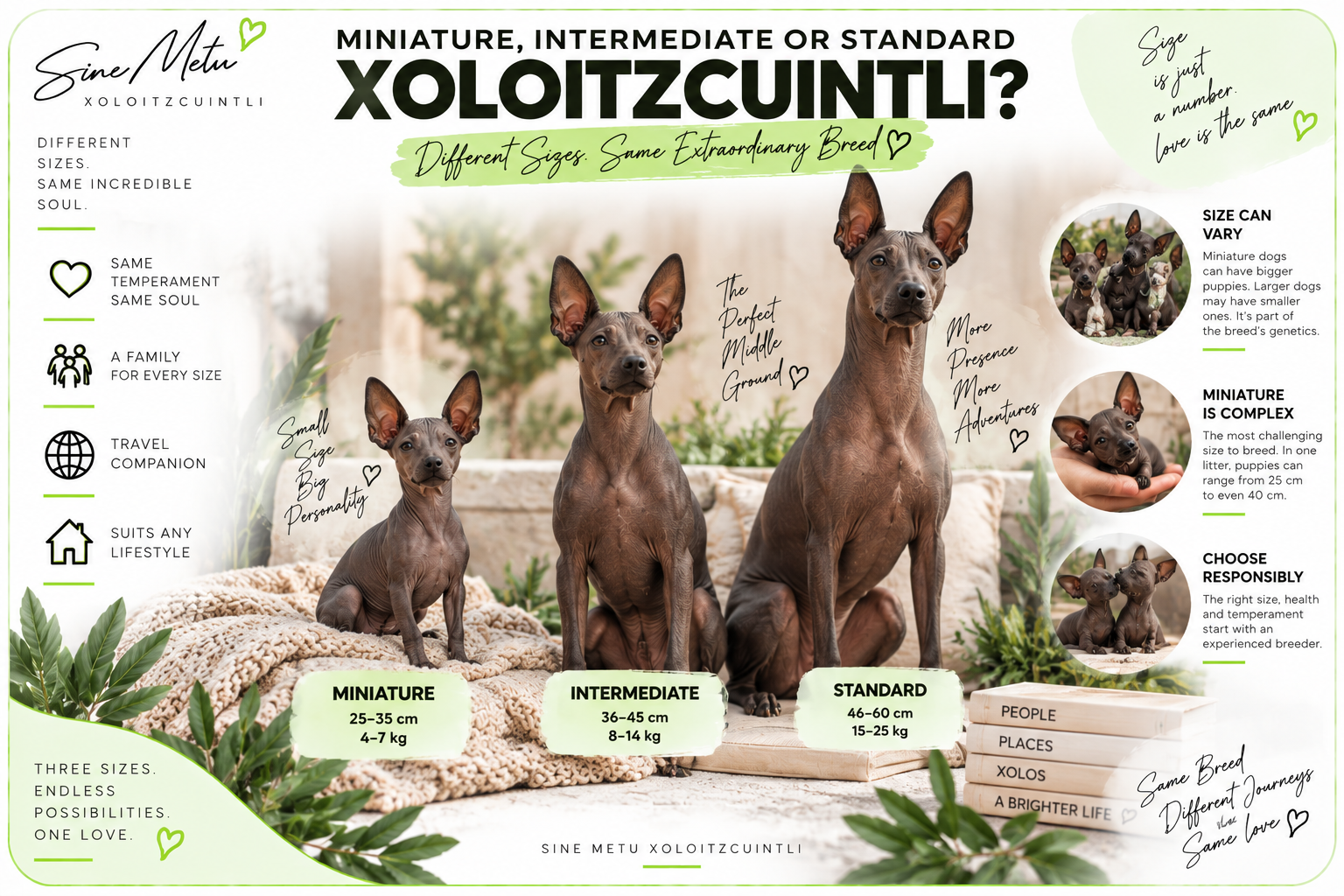
According to the FCI breed standard, Xoloitzcuintli has three size varieties:
VarietyHeight at WithersPractical Weight Range*Miniature25–35 cmapproximately 4–7 kgIntermediate36–45 cmapproximately 8–14 kgStandard46–60 cmapproximately 15–25 kg
*The weight ranges above reflect practical breed experience described in Life with Xolo. The FCI standard defines the varieties primarily by height and does not prescribe a fixed weight range.
The FCI describes the Miniature as primarily a companion dog, while the Intermediate and Standard varieties are traditionally described as watchdogs as well as companions.
However, this does not mean that a Miniature Xolo has a completely different personality.
All three sizes are Xoloitzcuintli.
The difference is primarily scale and physical construction, not a different breed temperament.
The Miniature is the smallest official Xolo variety, measuring 25–35 cm at the withers.
For many people, this is the most convenient size for everyday life.
A Miniature Xolo is easy to take with you, comfortable in an apartment, convenient for travel and simple to integrate into a busy household.
It is also physically small enough to be very manageable while still having the characteristic Xolo structure and personality.
For someone looking for a close companion rather than a larger watchdog, Miniature can be an excellent choice.
But there is an important detail that is often overlooked:
This is where Xolo becomes particularly interesting.
Historically, the three Xolo sizes were not as strictly separated as they are today.
Dogs of different sizes could reproduce with each other, and the breed therefore retained considerable variation in body size. Modern selection has separated and stabilized the three varieties more clearly, but the underlying genetic diversity has not simply disappeared.
This is why two Miniature parents can sometimes produce a puppy that grows larger than expected.
The experience described in Life with Xolo shows that puppies from Miniature parents can mature at very different heights. Examples observed in practice include approximately 27–38 cm at the withers, with some dogs entering the lower part of the Intermediate range.
In practical breeding, this means that a Miniature litter can contain puppies that mature very differently.
You may have a puppy that remains a clearly small Miniature, while another puppy from the same litter grows into a much larger individual.
This is one of the reasons predicting the final size of a young Xolo is not always simple.
Yes.
This is one of the most important things future owners should understand.
A Miniature parent does not carry a simple genetic switch saying:
“My puppies will all be Miniature.”
A Miniature Xolo can produce puppies that mature toward the upper end of the Miniature range and, in some combinations, puppies that enter the lower Intermediate range.
The same principle works in the other direction.
A larger Intermediate can produce a smaller-than-expected puppy, and size variation can occur even within carefully planned breeding.
This is not automatically a breeding failure.
It is part of the particular genetic history of the Xoloitzcuintli.
The FCI itself recognizes the three varieties but does not treat them as three separate breeds.
From a breeding perspective, Miniature Xolo is the most challenging of the three sizes to manage consistently.
Why?
Because the breeder is working within a relatively narrow size window:
25–35 cm.
There is not much room for error.
If a breeder repeatedly selects the smallest individuals and continuously breeds Miniature × Miniature without looking at the entire pedigree, structure and previous generations, the population can gradually become smaller.
Eventually, puppies can approach or fall below the lower limit of the FCI standard.
That is why responsible Miniature breeding is not simply:
“Find two tiny Xolos and breed them.”
It is much more complicated.
A breeder must constantly evaluate:
The goal is not to make the smallest possible Xolo.
The goal is to produce a correct, healthy Miniature Xolo within the breed standard.
This is particularly important for people who want a very small Xolo.
Two very small parents may produce small puppies — but if the breeder keeps selecting only the smallest offspring generation after generation, the size can move toward the lower edge of the standard.
Responsible breeding therefore requires balance.
Sometimes the correct breeding decision is not to choose the smallest dog.
A slightly larger Miniature with excellent structure, health and a suitable pedigree may be a much more valuable breeding partner than an extremely small dog.
This is exactly why Xolo breeding cannot be reduced to measurements alone.
Breeding for size without considering the whole dog is a mistake.
The Intermediate measures 36–45 cm at the withers.
For many people, this is the “middle ground” of the breed.
The dog is still relatively easy to live with, but has more physical presence than a Miniature.
An Intermediate can be an excellent choice for an owner who wants a Xolo that is neither very small nor large.
It can suit apartment life, a house, an active family or a quieter household, provided its need for walks, exploration, mental stimulation and human contact is met.
The Intermediate is also particularly interesting from a breeding perspective because it sits between the two other varieties.
Again, however, size should never be considered separately from structure and pedigree.
The Standard is the largest variety, officially 46–60 cm at the withers, with a tolerance of up to 2 cm for outstanding specimens under the FCI standard.
The Standard has more physical presence and traditionally has a stronger watchdog role in the breed standard.
For someone who wants a larger dog and enjoys the presence of a substantial companion, the Standard can be a beautiful choice.
It can still live closely with the family and does not need to live outdoors.
A Standard Xolo is not a different kind of Xolo emotionally.
It is simply a larger expression of the same breed.
There is no universally “best” Xolo size.
Instead, think about your everyday life.
But remember:
Size does not determine the quality of the Xolo.
A correct Miniature is not “better” than a Standard.
A beautiful Standard is not “more Xolo” than a Miniature.
They are three expressions of the same breed.
This is one of the biggest mistakes future owners can make.
A three-month-old puppy can look very small — and still grow considerably.
Another puppy from the same litter may appear larger early on and later mature into a completely different proportion.
That is why an experienced breeder should not promise an exact adult height simply by looking at a young puppy.
As described in Life with Xolo, the final adult size cannot always be predicted precisely at a young age.
A responsible breeder should instead evaluate the puppy together with:
parents + pedigree + previous litters + growth pattern + structure + family history.
That gives a much more realistic picture.
If you are choosing a Miniature Xolo especially, the breeder matters enormously.
Size selection is not something that should be improvised.
An experienced breeder knows which combinations tend to produce smaller, larger or more variable offspring and does not make breeding decisions based solely on the appearance of two dogs standing in front of them.
This is especially important because the Xolo has a history of size variation, and the breed still retains some of that genetic complexity.
A serious breeder should know their own lines.
They should know:
This is one reason choosing a Xolo from an experienced breeder is so important.
Your breeder should not simply sell you “a Miniature Xolo.”
They should help you understand what that particular puppy is likely to become.
If you want a Xoloitzcuintli, choose the size that fits your life.
But if you want to breed Xolos, forget the idea that choosing a size is simple.
It is not.
Miniature, Intermediate and Standard are official varieties of one breed, but their genetics do not behave like three completely isolated breeds.
Miniature breeding in particular requires careful selection because the desired range is narrow, size can vary significantly within families and even Miniature parents can produce larger offspring.
The objective should never be:
“How small can we make the Xolo?”
The correct question is:
“How do we preserve the correct Xolo while maintaining health, structure, temperament and a stable size?”
That is the difference between simply producing puppies and truly breeding Xoloitzcuintli.
And for a future owner, there is one final piece of advice:
Do not choose your Xolo only by centimeters. Choose the right breeder first — and let an experienced breeder help you choose the right dog for your life.

Is a mono-breed Miniature Xolo kennel.
We know everything about the Xolo breeding and even more.
We choose only the best Xolo bloodlines in the world for the breeding purpose in our kennel.
Our graduates live in more than 15 countries in Europe, the USA and Canada.
All our breeding dogs get tested for genetic diseases and are in excellent health condition.


