September 7, 2026
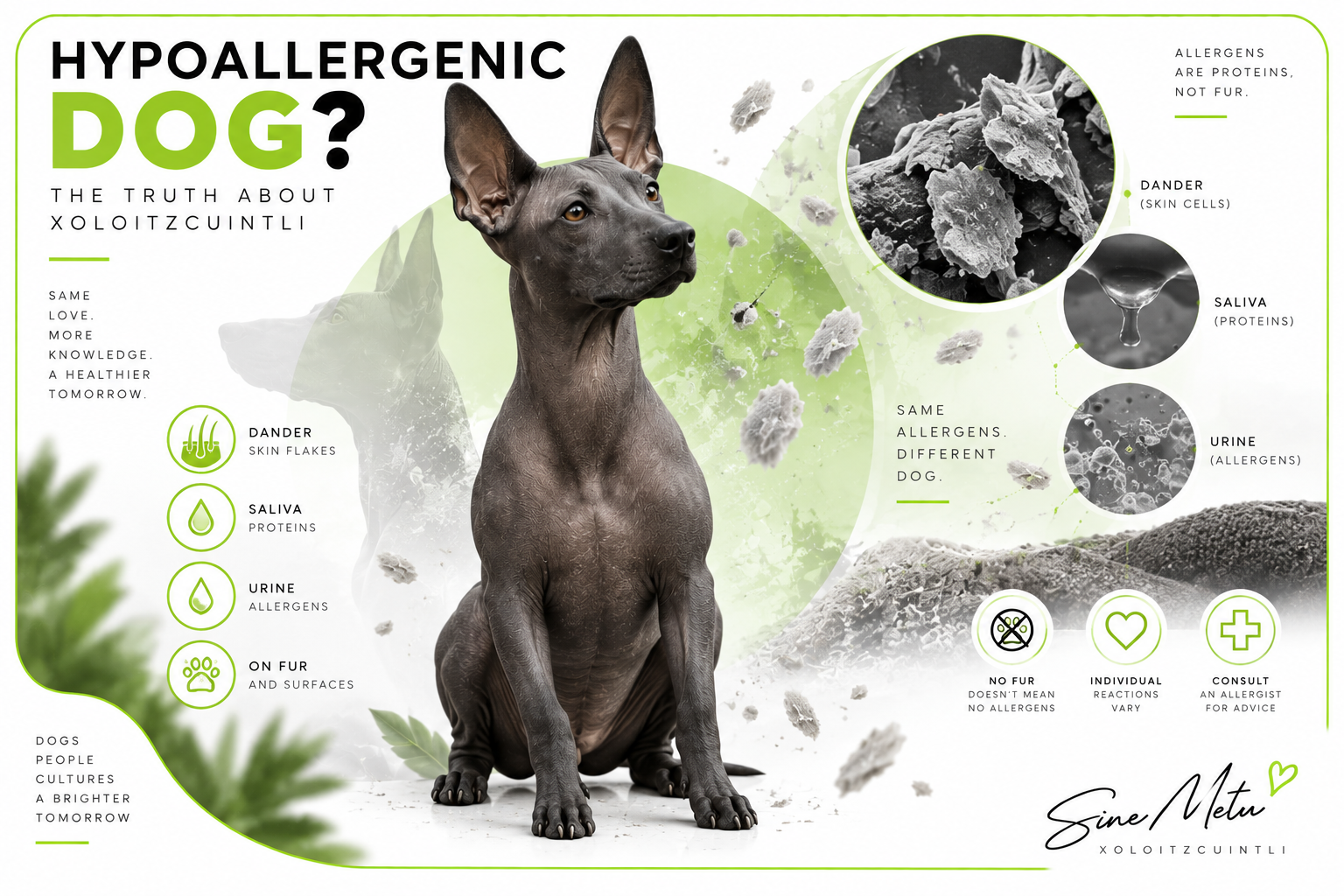
The Xoloitzcuintli is often described as one of the best dog breeds for people with allergies. The reason seems obvious: the hairless variety has little to no conventional coat, does not shed like most coated dogs, and leaves far less hair around the home.
But is it actually a hypoallergenic breed?
No.
In medical terms, there is no completely hypoallergenic dog breed. Even hairless dogs produce allergens.
The American Academy of Allergy, Asthma & Immunology (AAAAI) explains that allergic reactions to dogs are caused by proteins associated with dander, saliva, urine, and other biological materials — not simply by the hair itself.
So why is the Xolo often considered a good choice for allergy sufferers?
There is some truth behind the reputation, but it is very different from saying that the breed is allergen-free.
To understand the difference, we first need to look at what actually causes a dog allergy.
One of the most common misconceptions is that people are allergic to dog hair.
In reality, the immune system reacts to specific proteins produced by the animal.
These allergens can be present in or carried by:
Hair can act as a carrier for these substances, but the hair itself is not usually the allergen.
This is why simply removing the coat does not eliminate the possibility of an allergic reaction.
A dog can have almost no hair and still produce the proteins that trigger symptoms.
The confusion is understandable.
Dogs lick themselves, shed microscopic skin particles, and leave biological material on their coats. Those allergens can then become attached to hair and spread throughout the environment.
Hair can therefore transport allergens onto:
When an allergic person encounters dog hair and develops symptoms, it is easy to assume that the hair itself caused the reaction.
In reality, the hair is often simply the vehicle carrying the allergen.
This is one reason why the length, texture, or amount of a dog's coat cannot be used to determine whether a breed is genuinely hypoallergenic.
Research has not established a dog breed that can reliably be classified as hypoallergenic.
This is where the Xolo becomes particularly interesting.
The hairless variety has a very different physical appearance from most dogs, but its biology is still that of a dog.
It has:
Removing the coat does not switch off the production of allergenic proteins.
AAAAI specifically notes that even hairless dogs produce allergens.
Therefore:
Hairless does not mean allergen-free.
This distinction is essential when discussing the breed with people who have diagnosed dog allergies.
The word dander is often translated simply as “dandruff,” but the concept is broader.
Dander refers to tiny particles of skin and epithelial material that are naturally released from an animal's body.
These particles can carry allergenic proteins and become part of household dust.
Skin is constantly renewing itself. Dead epithelial cells are naturally shed, whether or not a dog has a visible coat.
That means:
No visible hair does not mean no skin particles.
This is why a hairless dog can still contribute allergens to its environment.
Yes.
Dog allergy is not a simple reaction to “fur.” It involves an immune response to specific proteins.
Several important dog allergens have been identified, including:
These proteins belong to different protein families and originate from different biological sources.
As a result, two people who both say “I am allergic to dogs” may actually be sensitized to different allergens.
This is one of the reasons why individual reactions can vary so dramatically.
Can f 1 is one of the best-known and most important dog allergens.
It belongs to the lipocalin family and is associated with saliva and epithelial material.
Studies have demonstrated Can f 1 in dog saliva and dander, where it can enter the home environment and come into contact with people.
For someone sensitized to this protein, the absence of a coat does not eliminate the source of exposure.
A dog does not need to shed visible hair to produce Can f 1.
Saliva is another important source of dog allergens.
A dog may leave saliva on its skin when grooming, on toys, furniture, floors, or directly on a person's skin.
Research has identified several allergenic proteins in canine saliva, including Can f 1, Can f 2, Can f 3, and Can f 6.
This means that a hairless dog can still cause symptoms through contact with saliva.
So the statement:
“I am allergic to dog hair.”
may actually describe a reaction to proteins carried by the hair rather than the hair itself.
Urine is another potential source of canine allergens.
One particularly interesting example is Can f 5, also known as prostatic kallikrein.
Can f 5 is produced by the prostate and is found in the urine of male dogs.
For some people, sensitization to Can f 5 may be particularly important. In certain cases, it can even be the only detectable component of a person's dog sensitization profile.
This demonstrates just how complicated the term “dog allergy” can be.
A person may react to a protein associated with urine even though the dog has no coat at all.
No.
This is another important distinction.
The fact that there is no universally hypoallergenic breed does not mean that every individual dog produces exactly the same amount or combination of allergens.
Allergen levels can vary:
Research has demonstrated substantial variation in Can f 1 levels between individual dogs.
In some cases, the differences between individual dogs within the same breed can be greater than the average differences between breeds.
This helps explain why one dog may seem much easier for an allergy sufferer to tolerate than another.
But that individual experience does not make the breed hypoallergenic.
This question has actually been investigated scientifically.
Researchers have compared levels of major dog allergens in breeds commonly marketed as hypoallergenic with those in other dogs.
One study published in the Journal of Allergy and Clinical Immunology examined Can f 1 levels in dogs considered hypoallergenic, including breeds such as the Labradoodle, Poodle, Spanish Water Dog, and Airedale Terrier.
The researchers did not find evidence supporting the existence of a truly hypoallergenic breed. In some measurements, dogs marketed as hypoallergenic even had higher levels of Can f 1 in their hair.
More importantly, there was substantial variation between individual animals.
Another study examined Can f 1 levels in homes with dogs commonly described as hypoallergenic.
The results found no significant difference in household allergen levels between homes with “hypoallergenic” dogs and homes with other dogs.
In other words, the label hypoallergenic does not mean that the home will be free of dog allergens.
This is where personal experience matters.
A person may react strongly to one dog and much less to another.
Different animals can have different allergen profiles, while individual people have different IgE sensitization profiles.
Therefore, it is entirely possible for someone to say:
“I cannot tolerate one dog, but I have no problem around another.”
That experience can be completely genuine.
But the correct conclusion is:
This particular person tolerates this particular dog better.
It does not prove:
This breed is hypoallergenic.
Those are two very different statements.
The reputation does have a logical basis.
A hairless dog simply does not have a conventional coat that constantly sheds visible hair throughout the home.
That can mean:
For some people, these characteristics may make living with a hairless dog more comfortable.
But the absence of visible hair should never be confused with the absence of allergens.
This is probably the simplest way to understand the entire subject:
Hairless ≠ allergen-free.
A hairless dog still has:
skin → epithelial shedding → dander
saliva → allergenic proteins
urine → allergenic proteins
skin secretions → biological proteins
The immune system can react to these substances regardless of whether the dog has a visible coat.
People often use the expression:
“I am allergic to dog skin.”
It is understandable in everyday language, but medically it is more precise to say:
“I am allergic to proteins produced by the dog and present in dander, saliva, urine, and other biological materials.”
The immune system is not necessarily reacting to the skin tissue itself.
It is reacting to specific proteins associated with the animal's biological material.
This distinction becomes particularly important when discussing hairless breeds.
Yes.
Allergens do not need visible hair to move through an environment.
Tiny epithelial particles and other allergenic material can settle on:
Some particles are small enough to remain airborne for periods of time.
Dog allergens can therefore be detected in places where a person is not directly touching the animal.
This is one reason why simply choosing a hairless dog cannot guarantee an allergy-free household.
The hairless variety does not shed a conventional coat in the way that coated dogs do.
But the skin is still a living, constantly renewing organ.
Epithelial cells naturally separate from the surface of the body.
Therefore:
“Does not shed hair” and “does not release allergens” are completely different statements.
A hairless dog can produce dander even though you will not find piles of hair around the house.
Sometimes, yes.
But there is no guarantee.
A person who already knows they are allergic to dogs should not choose a puppy simply because the breed is advertised as “hypoallergenic.”
A much more responsible approach is to discuss the allergy with a qualified allergist and, where appropriate, determine which dog allergens are involved.
Modern allergy testing can examine sensitization to individual components rather than treating “dog allergy” as one single substance.
Component-resolved diagnosis can include allergens such as Can f 1, Can f 2, Can f 3, and Can f 5.
This can provide much more information than simply asking whether someone reacts to “dogs.”
If allergies are already known, this is worth taking seriously.
A short visit with a dog does not necessarily reproduce the exposure that occurs after living with one permanently.
Living together means repeated exposure to:
Allergens can also accumulate in the environment.
For this reason, people with known allergies should discuss the situation with an allergist rather than relying only on a brief meeting with a puppy.
Managing the dog's environment and skin can help reduce exposure, although it cannot eliminate allergens.
Studies have shown that washing a dog can temporarily reduce the amount of detectable Can f 1 on its body.
The effect is not permanent, however, and regular washing is not a cure for dog allergy.
For a hairless dog, appropriate skin care is particularly important for maintaining a healthy skin barrier.
This includes:
Good skin care is important for the dog's health regardless of allergies.
It should not, however, be marketed as a way to make the dog “hypoallergenic.”
If someone has a confirmed dog allergy and chooses to live with a dog, reducing exposure may help.
Common recommendations from allergy specialists include:
The bedroom is particularly important because people spend many consecutive hours there.
Reducing allergen exposure in this room can therefore be useful.
Pay attention to bedding, carpets, upholstered furniture and other surfaces where allergens can accumulate.
HEPA air filtration can help reduce airborne particles, although it cannot remove every allergen from the environment.
Healthy skin and appropriate grooming are important for reducing unnecessary accumulation of skin debris.
Depending on the severity and type of allergy, a doctor may recommend medication or allergen-specific immunotherapy.
Possibly — but not because it is hypoallergenic.
The absence of a conventional coat may reduce visible shedding and change how allergens are distributed around the home.
For some individuals, that difference may be meaningful.
But there is no medical guarantee.
The most accurate description is therefore:
The Xoloitzcuintli is a hairless breed that may be better tolerated by some people with dog allergies, but it is not a hypoallergenic breed.
That wording is much more accurate than simply calling the breed “hypoallergenic.”
You will often see lists such as:
These descriptions can create a false sense of security.
Scientific evidence does not support the idea that there is a dog breed completely free of clinically relevant allergens.
The American Academy of Allergy, Asthma & Immunology and the American College of Allergy, Asthma & Immunology both emphasize that truly hypoallergenic dog breeds do not exist.
The difference between breeds is real, but it is not the same as eliminating the allergen.
No — not in the medical sense of the word.
The breed produces allergenic proteins just as other dogs do.
The important sources include:
Dander and epithelial particles
Saliva
Urine
Skin and other biological secretions
The absence of a conventional coat does not eliminate these substances.
What makes the Xolo different is not that it has no allergens, but that it has little to no conventional hair.
That can change the way allergens are carried and distributed in the home and may make the breed easier for some individuals to live with.
But it cannot guarantee an allergy-free experience.
The value of this breed should not depend on an exaggerated claim that it is “allergy-proof.”
Its real uniqueness is much more interesting.
The hairless Xolo has a distinctive skin, an unusual appearance, minimal conventional shedding, and a completely different physical relationship with its owner compared with most coated breeds.
For some people, those characteristics may make everyday life easier.
For others with significant dog allergies, they may not be enough.
Both experiences can be true.
The responsible approach is not to promise that a hairless dog will never cause an allergic reaction.
It is to understand the biology and make an informed decision.
The myth of the “hypoallergenic Xolo” comes from a simple assumption:
No hair → no allergy.
But the biology of dog allergy is much more complicated.
People with dog allergies react primarily to specific proteins, not simply to hair.
Those allergens can be associated with:
A hairless coat changes the amount and distribution of visible hair, but it does not switch off the production of allergenic proteins.
Scientific studies have also failed to identify a dog breed that can reliably be called completely hypoallergenic.
So the most accurate description is:
The Xoloitzcuintli is a hairless breed, not a hypoallergenic breed. Some people with dog allergies may tolerate an individual Xolo better than other dogs, but no breeder or medical professional can guarantee an allergy-free reaction.
For anyone with a known dog allergy, the safest approach is to speak with an allergist and understand their individual sensitization profile before bringing a dog into the home.
No fur does not mean no allergens.
Hairless does not mean hypoallergenic.
And an individual dog being well tolerated does not make an entire breed allergen-free.

Is a mono-breed Miniature Xolo kennel.
We know everything about the Xolo breeding and even more.
We choose only the best Xolo bloodlines in the world for the breeding purpose in our kennel.
Our graduates live in more than 15 countries in Europe, the USA and Canada.
All our breeding dogs get tested for genetic diseases and are in excellent health condition.


