August 31, 2026
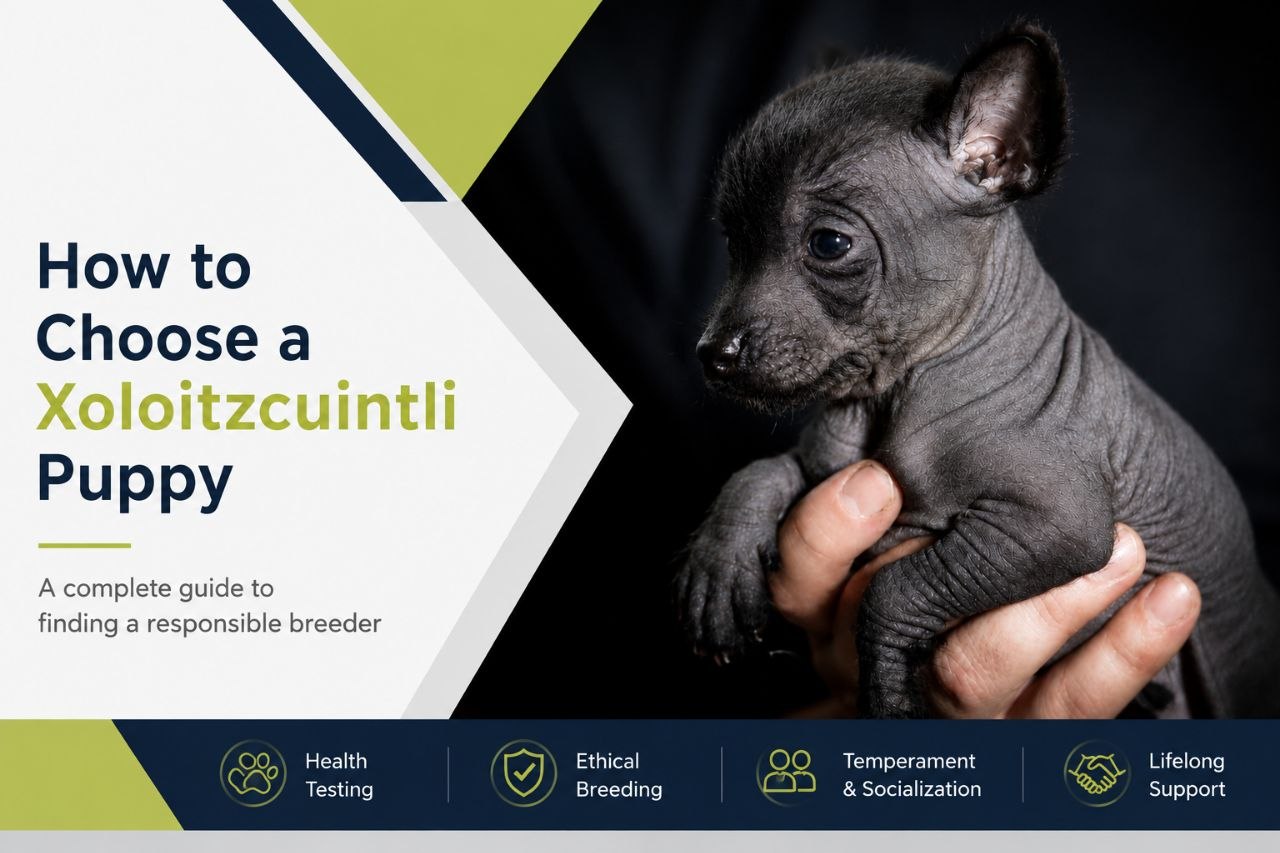
Choosing a Xoloitzcuintli puppy should never begin with a photo.
It should begin with questions.
Who are the parents?
Why was this particular breeding planned?
What do we know about their health, temperament and pedigree?
How are the puppies being raised?
What experiences do they have before leaving the breeder?
And perhaps most importantly — is the breeder willing to answer these questions openly?
A beautiful puppy can catch your attention in seconds.
But you are not choosing a photograph.
You are choosing a dog that may share your life for the next 12–15 years.
And what stands behind that puppy matters.
At Sine Metu, I believe responsible breeding begins long before puppies are born and continues long after they leave for their new homes.
So how do you recognize a responsible Xolo breeder — and how do you avoid making a decision you may regret later?
One of the biggest mistakes future owners make is searching only for an available puppy.
“Do you have puppies?”
“How much?”
“Male or female?”
“What colors are available?”
These are understandable questions. But they should not be the first or only questions.Before choosing the puppy, choose the breeder.
A responsible breeder should be able to explain why a particular litter was planned, what they know about the parents and their lines, what health examinations have been performed, how the puppies are raised and socialized, and what they expect from future owners.
In Life with Xolo, I emphasize something very simple: you need to understand what stands behind the puppy.
Health testing, knowledge of bloodlines and thoughtful breeding decisions can influence not only physical health, but temperament and psychological stability as well.
A responsible breeder should not become uncomfortable when you ask these questions.
They should expect them. And a good breeder will probably have plenty of questions for you, too.That is not a bad sign.It is one of the good ones.
Social media has made it extremely easy to create a beautiful image.
A clean background, adorable puppies, professional photographs and a polished Instagram account tell you very little about what actually happens behind the camera.
Look deeper. Ask where the puppies live.A sk about their mother. Ask how the puppies spend their days. Ask what socialization they receive. Ask what veterinary care they receive. Ask to see documentation for the parents rather than accepting “our dogs are completely healthly.”
Responsible breeding is not simply producing registered puppies.
The Xoloitzcuintli Club of America’s ethical code, for example, says breeding decisions should consider temperament, overall health, physical traits, inheritable disorders, genetic traits and soundness, and recommends breed health testing of sire and dam when applicable.
It also requires appropriate veterinary care for puppies before they leave.
A breeder should know considerably more about a litter than its birth date, sex and price.
Whenever reasonably possible, you should know where and how your puppy was raised.
You want to understand the puppy’s real environment, not only see carefully selected photographs.
Are the puppies part of everyday life?
Do they have appropriate human contact?
Are they accustomed to being handled?
Do they experience normal household sounds and activities?
Are they given opportunities to explore?
How does the mother behave?The father may live with another breeder, or even in another country, so physically meeting both parents is not always possible or necessary. International breeding programs commonly use dogs from different kennels and countries.
But the breeder should still be able to tell you exactly who the father is and provide information and documentation about him.
Transparency matters more than geography.
This is one of the most important distinctions future owners need to understand.
A dog looking healthy is not the same as a breeding dog having appropriate health examinations.
Before breeding, we need to look at the parents — not wait to see whether the puppies eventually develop problems.
The exact health-screening protocol can differ by country, registry, Xolo size variety and individual breeding program.
OFA also notes that breed-specific screening recommendations are not necessarily exhaustive and may change as new information and tests become available.
For Xoloitzcuintli, these are some of the areas I want future owners to understand.
Patella
Particularly Important in Miniature Xolos.
Patellar luxation is a condition in which the kneecap moves out of its normal position.
In Life with Xolo, I describe the grading system from Grade 0 through Grades 3–4 and explain that, for breeding, I prefer dogs with normal 0/0 results.
This is particularly relevant to the Miniature variety.
But there is an important point here:A perfect test result is not a lifetime guarantee.
Patellar problems can have more than one contributing factor.
Development, injury and inappropriate physical load can also matter.
That is why responsible breeding is not simply about collecting certificates; correct puppy raising and appropriate exercise matter too.
Eye Examination
Eyes are another important part of health screening.
In my book, I recommend examination by a veterinary ophthalmologist, such as an ECVO examination in Europe or an equivalent certified ophthalmological examination.
DNA tests for particular inherited eye conditions, such as forms of progressive retinal atrophy (PRA), may also be useful depending on the lines and available tests.
But a DNA panel should not automatically replace a proper clinical eye examination.
They answer different questions.
DNA Testing and DNA Profile
DNA testing can be a useful tool in a breeding program.
Depending on the laboratory and the lines involved, genetic testing can provide information about particular inherited variants.
A DNA profile can also provide permanent genetic identification and support parentage verification.
But buyers should understand an important distinction: “DNA tested” does not mean “tested for every possible disease.”
There is no single genetic test that proves a dog can never produce a health problem.
Responsible breeding means interpreting health results together with pedigree, relatives, phenotype, temperament and what is known about the line.
OFA makes a similar distinction: health databases and screening programs provide breeders with information for better breeding decisions, but phenotypic screening cannot provide absolute guarantees.
A cardiac examination can also be added to a breeder’s screening program.OFA maintains both cardiac and advanced cardiac screening databases alongside patellar, eye and DNA-based health records.
Whether it is part of the breeder’s core protocol or an additional examination will depend on the breeding program, local recommendations and individual dogs.
The principle is more important than simply accumulating the longest possible list of tests:test what is relevant, understand the results and use those results intelligently when planning a breeding.
There is nothing offensive about asking a breeder: “Can I see the health results of the parents?”
A responsible breeder should understand why you are asking.
Depending on the country, results may come from national kennel-club systems, veterinary specialists, ECVO, OFA or other recognized health databases and laboratories.
OFA specifically encourages puppy buyers to research the health records of parents and relatives when those records are available.
Do not become obsessed with logos and certificates, however.
A certificate is information.
The breeder still needs to know what that information means.
This is one of the things I wish every future Xolo owner understood before choosing a puppy.
You may arrive wanting:
“A black female.”
“A completely hairless puppy.”
“The smallest puppy.”
“The one with the prettiest head.”
But the puppy that looks perfect in a photograph may not be the best dog for your family.
Temperament matters.
One puppy may be bold and extremely active.
Another may be observant and sensitive.
One may thrive in a busy household.
Another may be much better suited to a quieter home.
This is why an experienced breeder who has watched the litter develop every day has information that you cannot get from a photograph.
Tell your breeder about your life, not only about the puppy you think you want.
Children? Other dogs? Cats? City or countryside? Frequent travel? Long working hours? Dog sports? Shows? A quiet companion? Your first dog? Your first Xolo?
The breeder should use this information when helping you choose.
This surprises some buyers.
Having enough money to buy a puppy does not automatically mean that a breeder has to sell you one.
A responsible breeder created that life.
They chose the parents, planned the litter, cared for the mother, watched the puppies being born and raised them through their most vulnerable weeks.
They have a responsibility to those puppies.
So yes — a responsible breeder may refuse a home.
And they may ask you many questions before accepting you.
Where will the dog live?
How much time will it spend alone?
What do you know about Xolos?
Do you understand their skin care?
What will happen when you travel?
What are your expectations of the dog?
Are all members of your household ready for a puppy?
Those questions are not an inconvenience.
They are part of responsible breeding.
Do not ask only: “Is the puppy socialized?”
Ask:“What exactly have you done?”
Socialization is not a checkbox.
Puppies should gradually learn about people, handling, different surfaces, sounds, everyday environments, grooming and appropriate new experiences.
For a Xolo, this matters enormously.
They can be highly observant and sensitive dogs.
The goal is not to create a puppy that never notices anything or is forced to love every stranger.
The goal is to build a puppy that can experience the world, process new information and recover appropriately.
A breeder cannot finish socialization for you.
But they can build the foundation.
You continue it.
9. Do Not Choose a Breeder
Only Because the Puppy Is Available Now
A puppy being available today is not a quality criterion.
Neither is distance.
Neither is the lowest price.
If you are going to live with this dog for many years, waiting for the right litter or travelling farther for the right breeder can be a very small inconvenience compared with choosing badly.
The XCA’s ethical recommendations likewise frame breeding around preservation of the breed, health, temperament and thoughtful selection of sire and dam — not simply producing puppies for availability.
Choose the breeding program first.
Then the litter.Then the puppy.
Not the other way around.
There is rarely one single sign that tells you everything about a breeder.
Look at the complete picture.
But I would become very cautious if a breeder:
- refuses to discuss or document the parents’ health;
- cannot explain why a particular mating was chosen;
- knows very little about the pedigree or dogs behind the puppy;
- does not want you to know how the puppies are actually raised;
- focuses almost entirely on color, rarity, size or price;
- is willing to sell immediately without learning anything about you;
- has no clear plan for socialization and puppy development;
- treats questions as an attack rather than a normal part of choosing a breeder;
- offers no meaningful support after the puppy leaves.
Registration alone does not prove responsible breeding.
A beautiful website does not prove responsible breeding.
A championship title alone does not prove responsible breeding.
And health tests alone do not prove responsible breeding.
You need to look at the whole breeding program.
11. What Should You Receive With Your Xolo Puppy?
Before paying a deposit, ask exactly what is included and what documentation you will receive.
Depending on the country and circumstances, this can include:
- registration or puppy documentation;
- microchip information;
- vaccination and veterinary records;
- pet passport where applicable;
- pedigree or documentation needed to obtain the pedigree;
- written purchase agreement;
- feeding information;
-ncare instructions;
- information about the parents and relevant health results.
At Sine Metu, I also believe education should travel with the puppy.
A new owner should not leave with a dog and a simple “good luck.”
They should understand what comes next.
This may be one of the most important criteria of all.
Ask yourself: Would I feel comfortable contacting this person six months from now if I had a problem?
A responsible breeder should care what happens to the dog after the sale.
Questions will come.
Skin may change.
Adolescence will arrive.
Behavior will change.
You may have questions about food, ears, teeth, clothing, socialization or training.
You should not expect a breeder to replace your veterinarian or trainer.
But you should expect them to care about the dog they produced.
For me, selling a puppy does not mean transferring a product.
It means entrusting one of my puppies to another family.
That is very different.
So, How Do You Choose the Right Xolo Puppy?
Do not begin by asking: “Which puppies are available?”Begin by asking:
“Who bred them, why were they bred, and how were they raised?”
Look at health.
Look at temperament.
Look at the parents.
Look at the environment.
Look at socialization.
Look at documentation.
And look carefully at the breeder’s attitude toward their dogs after they have been sold.
A responsible breeder will never be able to promise you a dog that will have absolutely no health or behavioral problems throughout its life.
Biology does not work that way.
What they can show you is that they have done the work: research, health screening, thoughtful selection, responsible raising, socialization, transparency and lifelong concern for the dogs they produce.
That is what you are really looking for.
Not simply a Xolo puppy.
A Xolo puppy with a responsible beginning.
Sine Metu Xoloitzcuintli
Based on principles from Life with Xolo.

Is a mono-breed Miniature Xolo kennel.
We know everything about the Xolo breeding and even more.
We choose only the best Xolo bloodlines in the world for the breeding purpose in our kennel.
Our graduates live in more than 15 countries in Europe, the USA and Canada.
All our breeding dogs get tested for genetic diseases and are in excellent health condition.


