October 7, 2026
Bringing a Xoloitzcuintli puppy home is not only about buying a bed, bowls and toys.
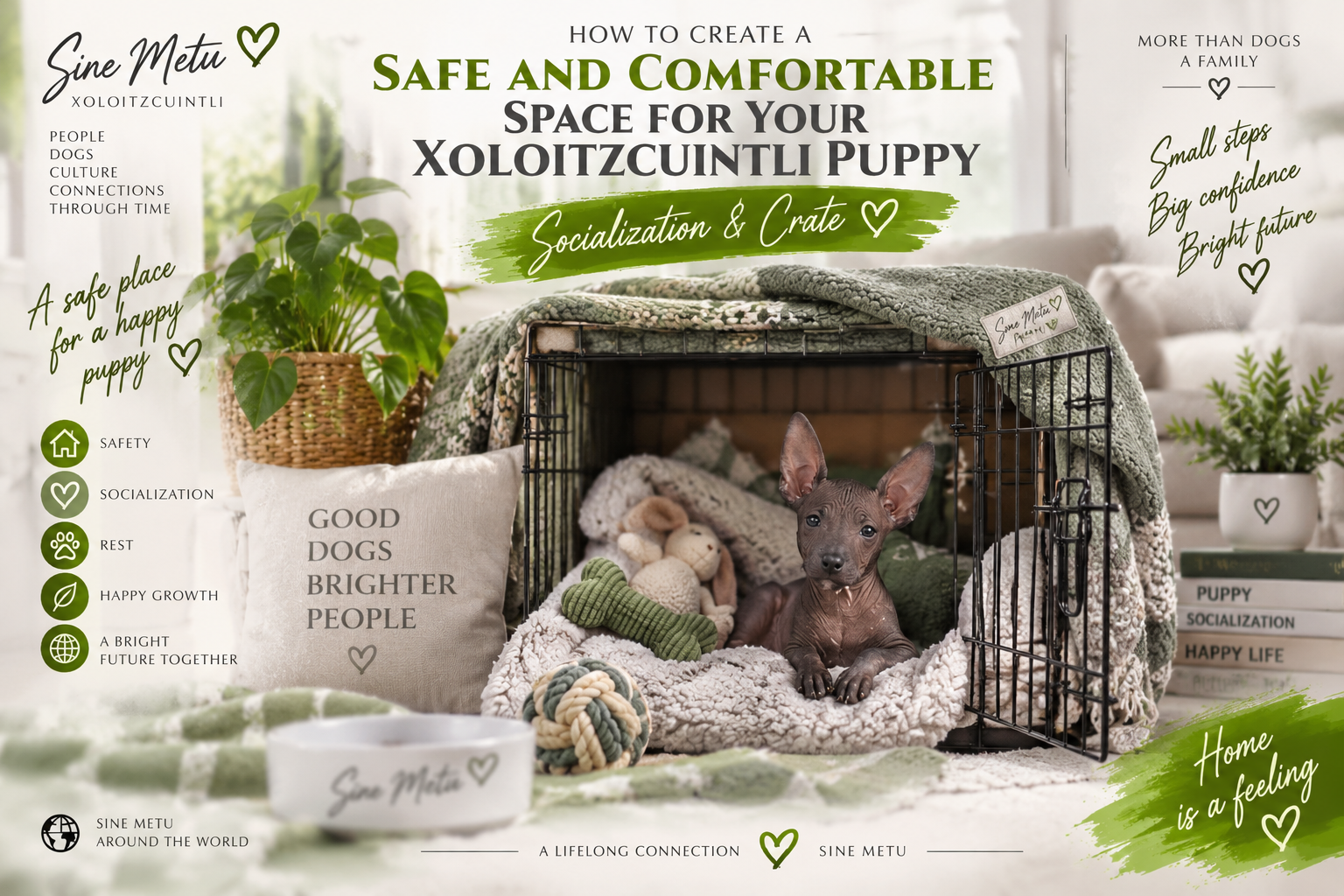
One of the first things a puppy needs is a safe and comfortable space of its own — somewhere it can sleep, rest, observe what is happening around it and retreat when it needs a break.
This is especially important during the first weeks in a new home. Everything is unfamiliar: new people, new smells, new sounds, new routines and a completely different environment.
The goal is not to isolate the puppy.
The goal is to give the puppy a place from which it can gradually learn to feel safe in the world.
At Sine Metu, we believe that a good puppy environment should combine freedom, supervision, socialization and a predictable place for rest.
A crate can be a very useful part of this arrangement — but it is only one part.
A safe space is simply an area where the puppy can relax without being disturbed.
It might include:
The exact arrangement depends on the home and the individual puppy.
What matters most is that the puppy knows:
“This is my place. I can rest here.”
A young puppy does not need constant entertainment.
It also needs sleep, quiet and the opportunity to switch off.
Socialization is sometimes misunderstood as exposing a puppy to as many people, dogs and situations as possible.
That is not the goal.
Good socialization means helping a puppy learn that the world is safe and manageable.
A puppy should gradually experience different people, sounds, surfaces, environments, vehicles and everyday situations — while being given enough space to process what it sees.
Current veterinary guidance emphasizes that socialization should be planned and positive. A puppy should not be forced into interactions when it is overwhelmed or frightened.
This is why a safe space is so important.
After something exciting or unfamiliar, the puppy needs somewhere to return to.
It can explore the world — and then come back home and rest.
During the first days, it is useful to show your puppy where its sleeping and resting area is.
Place the bed or crate somewhere that is part of normal family life but not in the middle of constant movement.
The puppy should be able to see and hear its people without being disturbed every few minutes.
For a social breed such as the Xoloitzcuintli, complete isolation is not the goal.
The puppy should feel that it is part of the family, while also having somewhere peaceful to sleep.
A crate can be an excellent tool for creating this kind of safe space.
But the way we think about the crate is important.
It is not a cage where the puppy is supposed to spend its day.
It is not a punishment.
It is not a substitute for interaction with the family.
And it is not something that every puppy must immediately accept with the door closed.
Instead, think of the crate as a small, protected sleeping and resting area.
Some puppies quickly decide that they like it.
Others need more time.
Both are normal.
Current AAHA guidance recommends introducing a crate through positive associations, leaving the door open initially and allowing the puppy to become comfortable with it voluntarily.
When you are at home and supervising your puppy, there is usually no reason to keep the crate closed.
Leave the door open.
The puppy can investigate it, go inside, come back out, play nearby and eventually decide to lie down.
This creates a completely different association.
The puppy does not think:
“My owner puts me in there.”
Instead, it learns:
“That is my comfortable place.”
This is the relationship we want.
The crate does not need to be complicated.
A washable bed or blanket is usually enough.
You can place a familiar-smelling blanket inside and, if appropriate for your puppy, a safe toy or chew.
For a Hairless Xoloitzcuintli, the sleeping surface is particularly important because there is little or no coat protecting the skin.
The surface should therefore be:
The puppy should not have a pile of unnecessary objects inside.
The space should remain simple and peaceful.
Yes, partially covering the crate can help create a quieter, more protected feeling.
It can make the space resemble a small den.
But there is an important difference between creating a cosy environment and isolating the puppy.
Good ventilation is essential.
The crate must not become too warm, especially for a Xoloitzcuintli.
And when the crate is simply available as a resting place, keeping the entrance open allows the puppy to choose whether to go inside.
This is one of the most important things for new owners to understand.
A puppy should not spend its day hiding in its safe space.
The purpose of a safe space is to support normal life — not replace it.
Your Xolo puppy should still:
The safe space simply gives the puppy somewhere to return to when it needs to recharge.
Young puppies often become tired long before they understand that they are tired.
They may continue playing, biting, running around and looking for stimulation even when they actually need sleep.
A quiet resting area can help the puppy learn the difference between:
activity
and
rest.
This is one reason we like having a clearly defined sleeping area.
The puppy learns that after activity comes a period of calm.
This becomes especially useful as the puppy grows and begins learning how to regulate excitement.
There will be moments when you cannot directly supervise your puppy.
Perhaps you need to take a shower, prepare food, answer the door or leave the house for a short period.
A properly prepared puppy-safe area can prevent many unnecessary accidents.
Young puppies explore with their mouths.
Electrical cables, small objects, household chemicals, medicines and other dangerous items must therefore be kept inaccessible. This kind of environmental management is an important part of puppy safety.
A crate can be part of this management when the puppy is already comfortable with it.
But it should not become an all-day solution.
One of the greatest practical advantages of helping a puppy become comfortable with a crate is that the same familiar space can later be useful outside the home.
A crate or appropriate carrier can become part of:
If the puppy already associates its resting space with comfort and familiarity, travelling can become easier.
The crate itself is not what makes travel comfortable.
The positive association with the space is what matters.
The puppy should have enough room to:
At the same time, the space does not need to be unnecessarily huge.
If you buy a crate that will eventually fit your adult Xoloitzcuintli, a divider can make the space more appropriate while the puppy grows.
The important thing is that the puppy can move comfortably without the crate becoming an enormous empty room.
The sleeping area and toilet area should have different purposes.
At Sine Metu, our puppies are accustomed to using a tray with pellets for toileting.
This means that when a puppy arrives in its new home, the family can continue with the familiar system while gradually developing outdoor toilet habits.
The crate does not replace the toilet area.
A puppy should not be expected to hold its bladder for unreasonable periods simply because it is in a crate.
After sleeping, eating, playing and waking up, the puppy should have an appropriate opportunity to toilet.
The goal is to teach the puppy a clear routine rather than simply expecting it to “hold it.”
This rule is absolute.
Do not send the puppy to its crate because you are angry.
Do not shout at the puppy and then lock it inside.
Do not use the crate as a place of punishment.
If the crate becomes associated with fear or unpleasant experiences, it can lose its value as a safe place.
Veterinary behavior guidance strongly recommends avoiding punitive methods and using reward-based learning instead.
We want the puppy to think:
“This is where I feel safe.”
Not:
“This is where I go when I have done something wrong.”
Do not force it.
This is where patience becomes much more important than training speed.
Leave the door open.
Let the puppy investigate.
You can place a familiar blanket inside.
You can reward voluntary interest in the space.
The first step may simply be looking inside.
Then one paw.
Then two.
Then walking in.
Later, lying down.
Eventually, the puppy may choose the crate by itself.
There is no prize for making this happen in one day.
The goal is not:
“My puppy must stay in the crate.”
The goal is:
“My puppy feels comfortable in the crate.”
If a puppy shows fear, panic or persistent distress, forcing the process can make the problem worse.
This is an important part of raising a balanced puppy.
Socialization is not only about adding experiences.
It is also about teaching the puppy that it can experience something new and then return to calm.
For example:
The puppy hears a vacuum cleaner.
It watches.
It may be curious.
It may move away.
You do not force it closer.
The sound stops.
The puppy returns to its safe space.
Later, you try again at a comfortable level.
This is much more useful than overwhelming the puppy with constant stimulation.
The puppy gradually learns:
New things happen. I am safe. I can take my time. I can come back to my people.
That is the foundation of confidence.
A physical safe space is only one part of the picture.
You are also part of your puppy's safe environment.
When your puppy encounters something unfamiliar, it should know that it can come back to you.
You should not push a worried puppy toward a person, dog or strange object with:
“Go on. Go say hello.”
Give the puppy time.
Observe its body language.
If it needs distance, give it distance.
If it wants to investigate, allow it to investigate.
Modern puppy guidance emphasizes that the owner should be a secure base during new experiences, rather than forcing interaction.
Trust comes before perfect obedience.
The arrangement that works for an eight-week-old puppy may not be appropriate for a six-month-old adolescent.
As your Xolo grows, the safe area can gradually become larger.
The puppy can gain more freedom as it demonstrates that it can handle that freedom safely.
You do not have to give the entire house to a puppy on the first day.
Freedom can grow together with maturity.
This is much easier than giving a puppy unlimited access immediately and then constantly correcting mistakes.
Ideally, your puppy learns several simple distinctions:
The home is for living and being with the family.
The sleeping area is for rest.
The toilet area is for toileting.
Outside is for walks, exploration and new experiences.
The crate is a safe place that is available when the puppy wants or needs to rest.
These distinctions create predictability.
And predictability makes life easier for a young dog.
This is probably the most important difference between our approach and the way some people imagine crate training.
We are not trying to teach a Xoloitzcuintli puppy to tolerate being locked away.
We are trying to teach the puppy how to live comfortably in a human home.
A crate can help with that.
A puppy-safe room can help.
A bed can help.
A predictable routine can help.
And, most importantly, a calm and trustworthy relationship with the owner helps.
When a puppy leaves Sine Metu, we do not want its new family to think only about obedience commands.
Before “sit,” “stay” or any other command, there is something more fundamental:
Does this puppy feel safe here?
Does it know where to sleep?
Does it know where to toilet?
Does it have somewhere quiet to retreat?
Does it have opportunities to explore?
Does it have enough sleep?
Does it have contact with its people?
Can it experience something new without being forced?
These things create the foundation on which everything else is built.
A crate is not a prison.
A safe space is not isolation.
And socialization is not forcing a puppy to experience everything.
The aim is to create a home where a young Xoloitzcuintli can explore, interact, rest and gradually become confident.
The crate can be part of that environment.
But the real safe place is bigger than the crate.
It is the whole environment you create for your puppy — and the relationship you build with them.
Give your puppy somewhere safe to rest.
Give them time to process the world.
Give them freedom gradually.
And most importantly, give them the feeling that they are safe with you.
That is where good socialization begins.

Is a mono-breed Miniature Xolo kennel.
We know everything about the Xolo breeding and even more.
We choose only the best Xolo bloodlines in the world for the breeding purpose in our kennel.
Our graduates live in more than 15 countries in Europe, the USA and Canada.
All our breeding dogs get tested for genetic diseases and are in excellent health condition.


