August 28, 2026
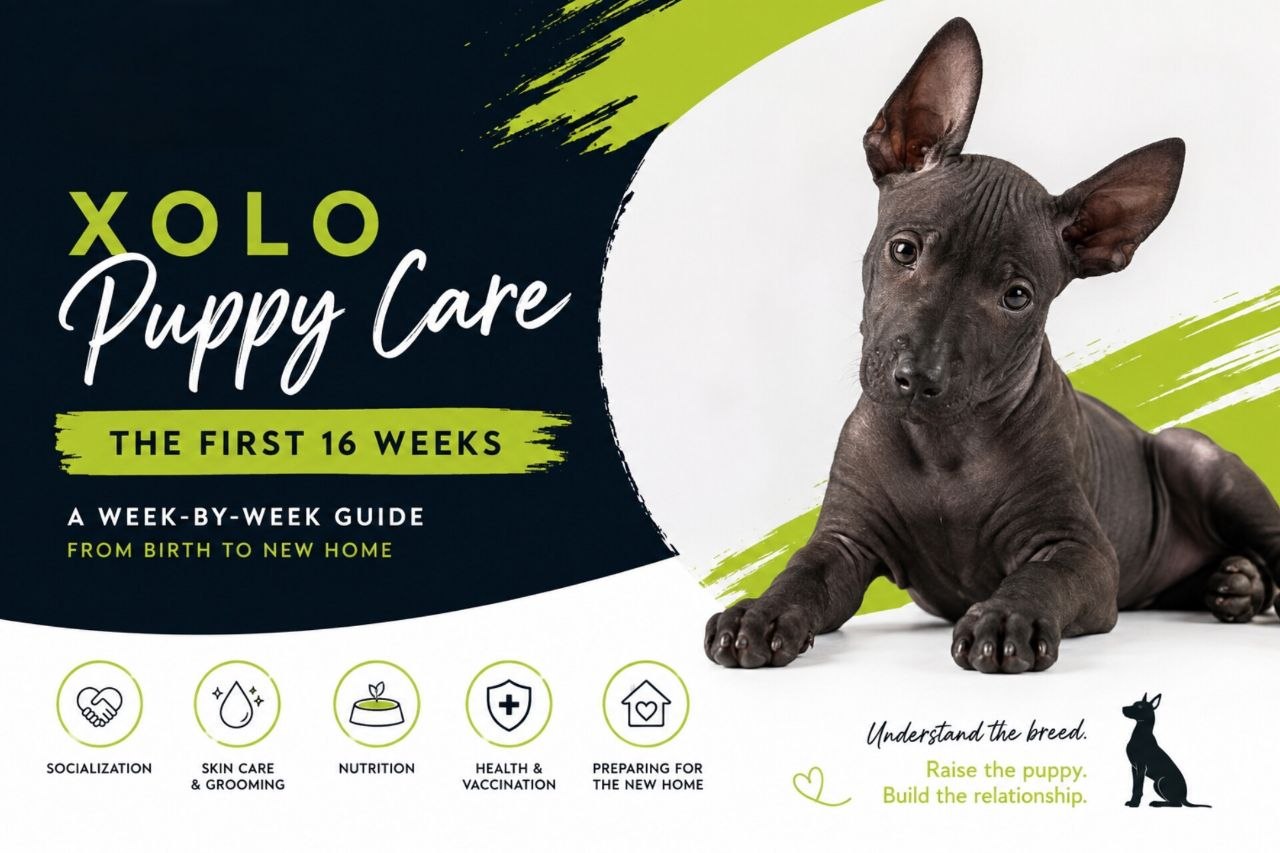
What should you expect during the first 16 weeks with a Xoloitzcuintli puppy?
Bringing a Xolo puppy home is not simply about feeding, walking and teaching a few commands.
The first weeks of a Xolo’s life are a foundation for everything that comes later: confidence, social behavior, communication with people, grooming habits, nutrition, and the ability to adapt to the world.
Xoloitzcuintli are an ancient, naturally developed breed.
They are intelligent, observant, emotionally sensitive and often cautious with unfamiliar people.
Because of this, raising a Xolo requires more than simply keeping a puppy healthy.
It requires intentional socialization, consistency, contact and understanding of the breed.
This guide is based on the practical approach described in Life with Xolo, a guide for people who want to understand the breed rather than simply buy a puppy
Important: Every puppy develops at its own pace.
The weeks below are a practical framework, not a rigid developmental schedule.
Socialization stages overlap, and the individual puppy should always be your main guide.
During the first week, the puppy’s world is very small.
The most important environment is its mother and littermates.
At this stage, the foundation is not about teaching commands or exposing the puppy to everything possible.
It is about stability, appropriate care and a safe environment.
For a responsible breeder, this period is the beginning of observing each individual puppy.
Even within one litter, puppies are not identical.As they grow, some may become more active, some calmer, some more sensitive and some more confident.
These differences become important later when matching a puppy with the right family.
The breeder’s role is not simply to raise a healthy litter.
It is to observe the puppies closely enough to understand who they are becoming.
Week 2 — Observation and Individual Development.
The second week continues to be primarily about stability and care.
There is no reason to rush the puppy into a busy world.
Instead, the breeder begins building a detailed understanding of the litter.
This is important because choosing a Xolo puppy should never be based only on appearance.
Color, the amount of hair on the head or tail, or how “hairless” a puppy looks are not the most important things when choosing a companion.
The puppy’s overall condition, behavior and developing temperament matter much more.A responsible breeder watches the puppies from the very beginning and gradually learns their individual differences.
Week 3 — The Beginning of Awareness
As the puppies grow, their environment gradually becomes more important.
The goal is still not to overwhelm them.
A good breeder introduces experiences gradually and observes how each puppy responds.
This principle will become increasingly important during the following weeks.
With Xoloitzcuintli, quality of experience matters more than quantity.
The goal of socialization is not to expose a puppy to as many things as possible.
The goal is to help the puppy learn:“New things can be safe.”
Week 4 — The World Starts to Expand
By this stage, the puppies are beginning to experience more of their environment.
The foundation of socialization is already being created through:
interaction with their mother;
interaction with littermates;
contact with people;
household sounds;
different everyday situations.
This early period is extremely important for an ancient breed such as the Xoloitzcuintli.
Many Xolos are naturally cautious around unfamiliar people.
This is not necessarily aggression.
It is a breed characteristic connected to their alert and observant nature.
That is why early, thoughtful exposure is so important.
Week 5 — Learning Through Everyday Life
Now everyday experiences become part of the puppy’s education.
The puppies can gradually experience:different sounds;
different people;
household activity;
handling;
grooming-related contact;
different surfaces and objects.
This does not mean creating chaos around the litter.
Quite the opposite.Socialization should be systematic.
A puppy does not need to experience everything in one day.
Small, positive experiences are much more valuable than overwhelming exposure.
This principle continues throughout the puppy’s development.
Week 6 — Grooming Becomes Part of Life
For a hairless Xolo, skincare is not an optional cosmetic routine.
It is part of everyday life.This is why puppies should gradually become comfortable with handling and grooming.
They can be introduced to:
touching the paws;
touching the ears;
touching the tail;
touching the belly;
nail care;
bathing;
towel drying;
wearing and removing clothing.
These experiences should be calm and positive.
The goal is not simply to make a puppy tolerate grooming.
The goal is to teach the puppy that human hands are safe.
This becomes particularly valuable later, when the owner needs to bathe the dog, care for its skin, trim its nails or examine its body.
Week 7 — Xolo Puppy Skin Care
By seven weeks, puppies can already be introduced to a more complete grooming routine.
For a hairless Xolo, the basic principle is simple:cleanse → condition → moisturize when necessary.
A gentle dog shampoo should be used rather than human cosmetics.
Human shampoos and conditioners are formulated for human skin and can disrupt the dog’s skin barrier and contribute to dryness or irritation.
The exact skincare routine should depend on the puppy’s individual skin.
If the skin is dry, additional moisturization may be appropriate.
If there are blackheads or age-related skin changes, these should not automatically be treated as a disease.
Puppies can naturally have black spots or minor age-related skin changes, but significant inflammation, pus, infection or rapidly spreading lesions require professional assessment.
The important lesson is:Xolo skin needs care — but not aggressive care.
Week 8 — The Puppy Starts Preparing for a Family
Around this period, the puppies are becoming increasingly ready for the next stage of their lives.
This is also the time when a responsible breeder should know the puppies well enough to understand their differences.
One puppy may be more confident.
Another may be more sensitive.
Another may be highly active and curious.
Another may prefer a quieter environment.
This is why I do not believe that choosing a puppy should simply mean pointing at the cutest one in a photograph.
The better question is: Which puppy is the right match for this particular family?
A responsible breeder has been watching the puppies since birth and can help make that decision.
Week 9 — A New Home Is a Major Change
When a Xolo puppy moves to a new family, everything changes.
New people.New smells.New rooms.
New sounds.
New rules.
The puppy has left its mother, littermates and familiar environment.
This is a major adjustment, and the first days should therefore be calm.
A puppy may:
hide;appear confused;
sleep more;be unusually quiet;
become restless;
observe everything carefully;
take time before approaching its new owners.
These reactions can be completely normal.
The puppy is not necessarily unhappy or “badly socialized.”
It is adapting.
The first goal is security.
Week 10 — Building Trust
Now the owner begins creating the relationship that will become the foundation of the dog’s life.
Do not expect perfection.
The puppy needs to learn:
where it sleeps;
where it eats;
where it goes to the toilet;what is allowed;
how the household works;
how to communicate with its people.
The most important thing is consistency.
Xolos are highly observant and emotionally sensitive.
Harsh methods and pressure can damage the relationship instead of improving behavior.
Training is not simply a collection of commands.
It is a way of living together.
Week 11 — Socialization Continues
Socialization does not stop because the puppy has moved into your home.In fact, this is where the owner’s responsibility becomes especially important.
If vaccination restrictions still apply, socialization can still happen safely through observation and controlled experiences.
The puppy can experience the world:
from your arms;
from a safe environment;
through observation;
during controlled car trips;
through household experiences;by meeting appropriate people.
The puppy can see cars, hear traffic, experience different sounds and observe people without necessarily having direct contact with potentially contaminated environments.
Vaccination restrictions do not mean socialization should stop.
They mean that socialization needs to be adapted to the puppy’s level of protection.
Week 12 — Vaccination and the Wider World
Vaccination is one of the most important parts of puppy care.
Primary vaccination commonly begins at approximately 6–8 weeks, with subsequent vaccinations given according to a veterinarian’s recommended schedule.
The exact schedule depends on the puppy, vaccine, lifestyle and regional disease risks.
Rabies vaccination is generally given after 12 weeks, according to local regulations and veterinary recommendations.
After vaccination, the puppy still needs appropriate protection while immunity develops.
This is why owners should follow their veterinarian’s instructions regarding when and where the puppy can safely walk and interact with other dogs.
The goal is to balance two important needs: protect the puppy from disease while continuing appropriate socialization.
Week 13 — The World Opens Up
Once the vaccination and waiting period are complete, the puppy can begin experiencing much more of the world.
This is an extremely important stage for a Xolo.Start gradually.
Introduce:
quiet streets;
busier streets;
different surfaces;
cars;public transport;
new places;
appropriate dogs;
different people;
new sounds.
Do not try to do everything at once.
A Xolo does not need to become indifferent to the environment.
A well-socialized Xolo can still be sensitive, cautious or alert.
The important difference is that the dog can manage its reaction, stay connected with its owner and recover from stress.
Week 14 — Grooming, Clothing and Everyday Skills
At this stage, grooming should already be becoming a normal part of life.
For a hairless Xolo, owners should become comfortable with:
bathing;
skin observation;
moisturizing when needed;
ear care;
nail trimming;
dental care;
appropriate clothing.
Clothing is not simply fashion for a Xolo living in a cold climate.
It can be necessary protection from cold, wind and wet conditions.
However, clothing must fit correctly and should not cause rubbing or irritation.
Soft, flexible materials and a comfortable fit are especially important because the fabric is in direct contact with the skin.
And remember: the correct clothing is the clothing the dog can wear comfortably without constantly noticing it.
Week 15 — Nutrition and Routine
Nutrition becomes one of the foundations of healthy growth.
When a puppy arrives in a new home, the safest approach is usually stability rather than experimentation.
If the breeder has established a successful diet, changing food suddenly is unnecessary.
A sudden change can cause digestive problems even when the new food is of good quality.
In the guide, I recommend beginning with a balanced puppy diet and maintaining a controlled feeding routine.
During puppyhood, meals are generally divided into several portions throughout the day, with the exact amount adjusted according to the puppy’s condition and the food being used.
Fresh water should always be available.
And one important rule: do not judge a puppy’s nutritional needs only by how hungry it looks.
Xolos can be extremely convincing when asking for food.
Their appetite does not automatically mean they need more food.
Body condition, growth and overall health are much more useful indicators.
Week 16 — Preparing for the Next Stage
At approximately 16 weeks, the puppy is entering a completely different stage of life.
The foundation has already been built.
But it is not finished.Socialization continues.
Training continues.
Grooming continues.
The relationship with the owner continues to develop.
The puppy now needs regular exposure to the real world — but always in a way that considers its individual temperament.
The next months can bring new challenges.
Xolos may enter adolescence relatively early, and owners can suddenly feel that the puppy that was previously easy to understand has become much more independent.
This is normal.
The answer is not harshness.
It is consistency.
The Most Important Thing About the First
16 Weeks There is no perfect Xolo puppy.
There is no magic week when socialization is suddenly “finished.”
And there is no single checklist that works identically for every dog.
The first months are about building a foundation.
A puppy should learn that:
people are safe;
new experiences can be manageable;
grooming is normal;
the owner is predictable;
the world is worth exploring.
Socialization is not about creating a dog that never reacts.
A well-socialized Xolo can still be sensitive.
It can still notice everything.
It can still be cautious around strangers.
The difference is that it can remain connected to its person, recover from stress and function confidently in everyday life.
That is the goal.
Not a fearless dog.
A confident dog that knows how to live in the human world.
A Xolo Puppy Is More Than a Puppy
One of the biggest mistakes a future owner can make is to focus only on the moment of purchase.
A Xolo is not simply a beautiful, unusual-looking dog.
It is a breed with its own temperament, sensitivity, grooming needs and way of communicating.
That is why choosing a Xolo should begin with learning about the breed.
And choosing a puppy should begin with choosing a responsible breeder.
A responsible breeder does more than produce puppies.
They observe them, socialize them, care for them, prepare them for life and help match each puppy with an appropriate family.
They should also remain available to the owner after the puppy leaves.
Because the relationship between breeder and owner should not end on the day the puppy goes home.
Final Thoughts from Sine Metu
The first 16 weeks are not about creating a perfect dog.
They are about creating a strong foundation for the relationship that will last for many years.
Feed the puppy well.
Protect its health.
Care for its skin.
Teach it calmly.
Expose it to the world gradually.
Respect its sensitivity.
Give it boundaries.
And, most importantly, build trust.
Because living with a Xolo is not about controlling the dog.
It is about learning to understand one another.
That is the philosophy behind Life with Xolo — a practical guide created from years of experience with the breed, for people who want to understand the Xolo before simply bringing one home.
Sine Metu — understand the breed. Raise the puppy. Build the relationship.

Is a mono-breed Miniature Xolo kennel.
We know everything about the Xolo breeding and even more.
We choose only the best Xolo bloodlines in the world for the breeding purpose in our kennel.
Our graduates live in more than 15 countries in Europe, the USA and Canada.
All our breeding dogs get tested for genetic diseases and are in excellent health condition.


