September 6, 2026
Clothing is not simply an accessory for a hairless Xoloitzcuintli. In a climate with cold seasons, it can be an important part of everyday care.
However, choosing clothing for a Xolo is very different from choosing clothing for a dog with a normal coat.
The fabric is in direct contact with the skin. There is no layer of fur protecting the dog from rough seams, poorly designed cuts or unsuitable materials.
That is why fit, fabric, construction and comfort matter much more for a Xoloitzcuintli than for many other breeds.
The goal is simple:
The clothing should protect the dog without becoming a source of discomfort or skin irritation.
In a European climate with distinct seasons, clothing is generally needed during the colder parts of the year:
During summer, clothing is generally unnecessary.
The hairless Xolo's skin benefits from exposure to sunlight, and tanning is a natural part of the condition of the skin. Covering the dog unnecessarily during warm weather interferes with these natural processes.
So clothing should not be viewed as something a Xolo needs to wear all the time.
It is a protective tool used when the weather requires it.
Most dog clothing is designed with coated dogs in mind.
For a dog with a thick coat, fabric and seams have relatively little direct contact with the skin.
For a hairless Xolo, the situation is completely different.
The fabric lies directly against the skin. This means that:
This is why clothing for a Xolo needs to be selected much more carefully.
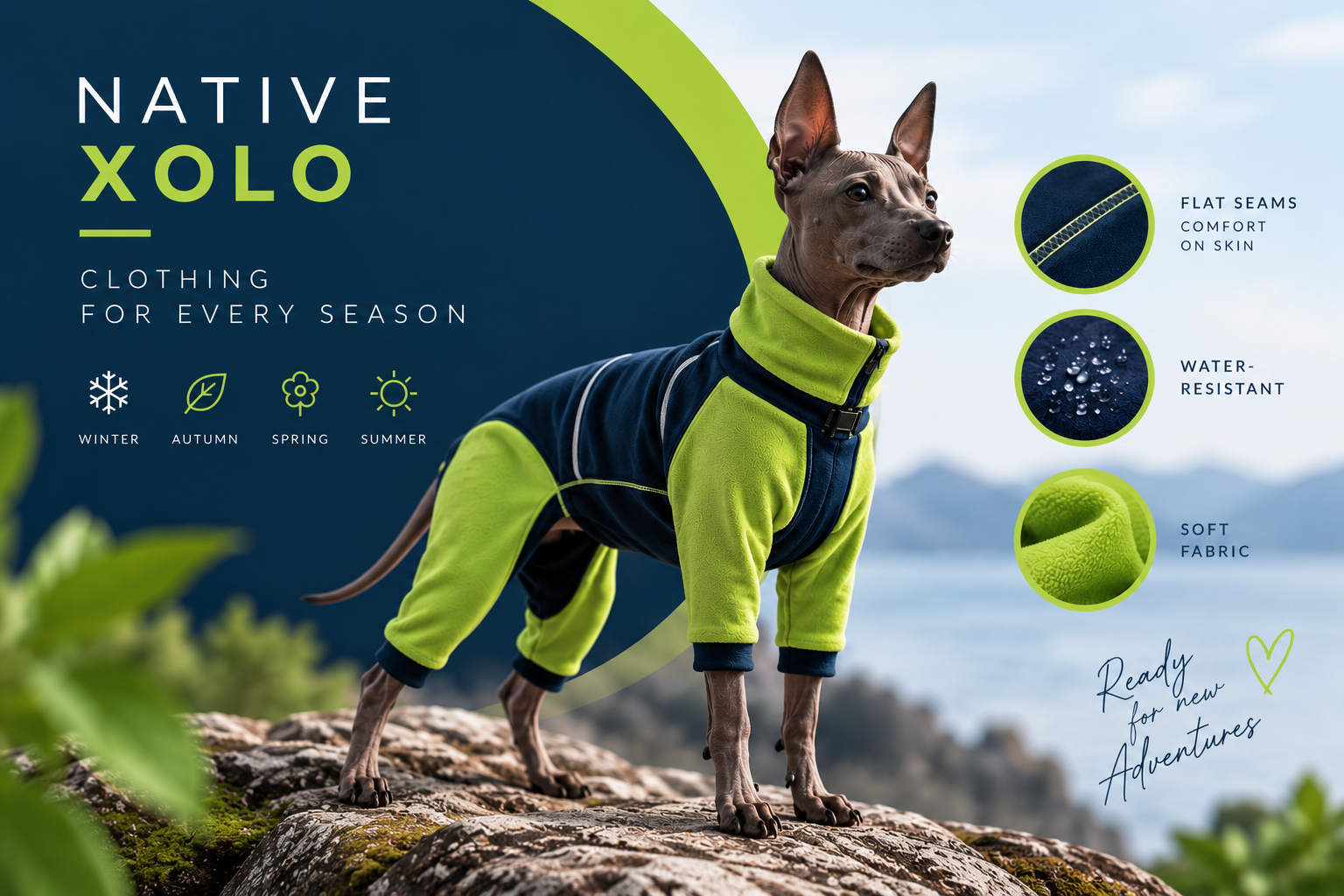
One of the most important details when choosing Xoloitzcuintli clothing is the construction of the seams.
Avoid rough internal seams whenever possible.
The best clothing either has no problematic internal seams or uses very flat seams that do not rub against the skin.
This may seem like a small detail when looking at clothing from the outside.
For a hairless dog, however, it can make a major difference.
A garment can look beautiful and fit the measurements perfectly but still be unsuitable if the internal seams constantly rub the skin.
Comfort should always come before appearance.
The ideal clothing should be made from soft, flexible fabric that allows the dog to move naturally.
The material should not create unnecessary friction or restrict movement.
Fleece can work very well for many Xolos, particularly during colder weather.
However, not every Xolo reacts to fleece in the same way.
Some dogs, particularly those with light or sensitive skin, may develop irritation when wearing fleece.
In these cases, it may be better to choose:
The most important rule is simple:
If a garment causes discomfort, irritation or a rash, it is not the right garment—even if it looks perfect.
During transitional seasons, a Xolo usually does not need the heaviest winter clothing.
Useful options include:
A higher neckline can be particularly useful.
A sweater or jumpsuit with a turtleneck-style closed neck can help protect the neck, chest and body from cold air.
For outdoor walks, lightweight clothing can also be combined with a vest when additional protection is needed.
Winter requires more complete protection.
It is useful to have several garments designed for different temperatures rather than relying on one outfit for every winter day.
For example:
A lighter jumpsuit or coat may be enough.
A properly insulated winter garment provides more protection.
Additional protection may sometimes be needed, such as:
The colder the weather, the more important it becomes to protect not only the body but also areas that have little natural protection.
Not necessarily.
Indoor clothing depends on both temperature and humidity.
If the home is comfortably warm—around 18–20°C or above—clothing is generally unnecessary.
If the indoor temperature is around 15°C, especially when humidity is high, a lightweight home garment such as a pajama-style suit may be useful.
This is especially relevant because Xolos can tolerate dry cold better than cold, damp conditions.
A small additional layer can sometimes make the dog much more comfortable in a cool and humid environment.
Cold is not the only factor to consider.
Damp weather can be particularly uncomfortable for a hairless Xolo.
Rain, wet ground and high humidity can make a dog feel cold much faster than dry winter weather.
A Xolo may show a very obvious dislike of walking in rain or damp conditions.
This is not necessarily a sign that something is wrong.
It may simply mean that the weather is uncomfortable for a hairless dog.
This is where appropriate waterproof or protective outer clothing can be particularly useful.
The dog's behavior is often a better guide than the number on a thermometer.
A Xolo that is uncomfortable in the cold may:
These signs can be particularly obvious during cold and wet weather.
The most useful rule is:
Watch the dog, not just the thermometer.
Different dogs have different levels of cold tolerance.
There is no universal Xolo clothing size.
Different manufacturers use different:
One brand may primarily use back length, while another may rely more heavily on chest or neck circumference.
That is completely normal.
For this reason, do not simply buy the same numerical size from another brand.
Always follow the specific manufacturer's measurement instructions.
Before ordering clothing, check exactly which measurements the manufacturer requires.
Depending on the garment, this may include:
The important point is not to guess.
Measure the dog according to the brand's instructions and compare the measurements with its own size chart.
The size number itself means very little without the manufacturer's measurements.
The garment should sit comfortably on the body without restricting normal movement.
A good garment should:
The dog should be able to move naturally rather than constantly adjusting to the clothing.
In an ideal situation, the garment becomes almost unnoticeable.
The best clothing is clothing the Xolo barely notices.
Clothing designed for Italian Greyhounds can sometimes be a useful starting point for a Xolo.
The proportions and body shape can make some of these garments suitable.
However, Xoloitzcuintli generally have a somewhat more substantial, denser body structure.
Therefore, an Italian Greyhound garment should never be assumed to fit a Xolo perfectly.
Always check the actual measurements and how the garment sits on the individual dog.
This is one of the most important things to monitor.
After introducing a new garment, pay attention to the skin.
If you notice:
the garment may not be suitable.
Do not keep using it simply because it looks attractive or because the size appears correct.
Skin comfort comes first.
A garment that causes irritation is the wrong garment.
No.
Clothing should be used when protection is actually needed.
Constantly keeping a dog dressed in warm conditions can interfere with natural thermoregulation and may gradually make the Xolo more sensitive to cold.
The goal is not to keep the dog wrapped up.
The goal is to maintain a comfortable balance.
Cold itself should not be treated as an illness.
A Xolo does not simply "catch a cold" in the same way people commonly describe human colds.
During colder weather, the body uses more energy, and appropriate nutrition and care help support the dog's normal needs.
The purpose of clothing is therefore comfort and protection, not treating illness.
In very cold conditions, clothing may need to go beyond a coat or jumpsuit.
Depending on the weather and the individual dog, additional protection can include:
These are particularly relevant during severe cold.
Again, the same principle applies: anything worn by the dog should be comfortable and should not cause rubbing or restrict movement.
For a Xolo living in a European climate, a practical wardrobe can include several levels of protection.
For cool autumn or spring days:
For colder autumn, spring and mild winter:
For freezing conditions:
Having several options is more practical than using one very warm garment throughout the entire cold season.
There is no single "perfect" coat for every Xolo.
The right choice depends on:
But several principles are universal:
Soft fabric.
Correct fit.
Minimal friction.
Flat seams.
Freedom of movement.
Protection without overheating.
The purpose of clothing is not to make a Xolo look dressed.
It is to make the dog comfortable enough to enjoy life in a climate that was not designed for a hairless breed.
Before buying a new garment, ask:
☐ Is the fabric soft?
☐ Is it flexible enough for normal movement?
☐ Are the internal seams flat?
☐ Are there any rough edges touching the skin?
☐ Does the garment fit the dog's actual measurements?
☐ Does it protect the chest and body adequately?
☐ Does it work for the current temperature?
☐ Could the fabric cause irritation?
☐ Is the dog comfortable while moving?
☐ Is the dog getting too warm?
If the answer to these questions is yes, you are much more likely to have found a suitable garment.
Xoloitzcuintli clothing should never be chosen simply by appearance.
For a hairless dog, clothing is in direct contact with the skin, which makes fabric, seams, construction and fit essential parts of proper care.
Use lighter clothing during transitional weather, warmer and more protective garments in winter, and additional protection when severe cold requires it.
At home, clothing depends largely on temperature and humidity.
And above all, learn to read your individual Xolo.
A comfortable Xolo moves normally, behaves naturally and does not constantly notice its clothing.
The best clothing is the clothing that protects the dog without getting in the dog's way.

Is a mono-breed Miniature Xolo kennel.
We know everything about the Xolo breeding and even more.
We choose only the best Xolo bloodlines in the world for the breeding purpose in our kennel.
Our graduates live in more than 15 countries in Europe, the USA and Canada.
All our breeding dogs get tested for genetic diseases and are in excellent health condition.


