September 6, 2026
The Xoloitzcuintli is a naturally clean breed, and one of the biggest mistakes owners can make is assuming that more grooming is always better.
Hairless Xoloitzcuintli do not need the same type of routine care as breeds with heavy coats. Their skin, ears and overall hygiene are different, and many grooming problems come from over-cleaning, excessive products or unnecessary manipulation.
At the same time, basic maintenance is still important.
A good Xoloitzcuintli care routine should include:
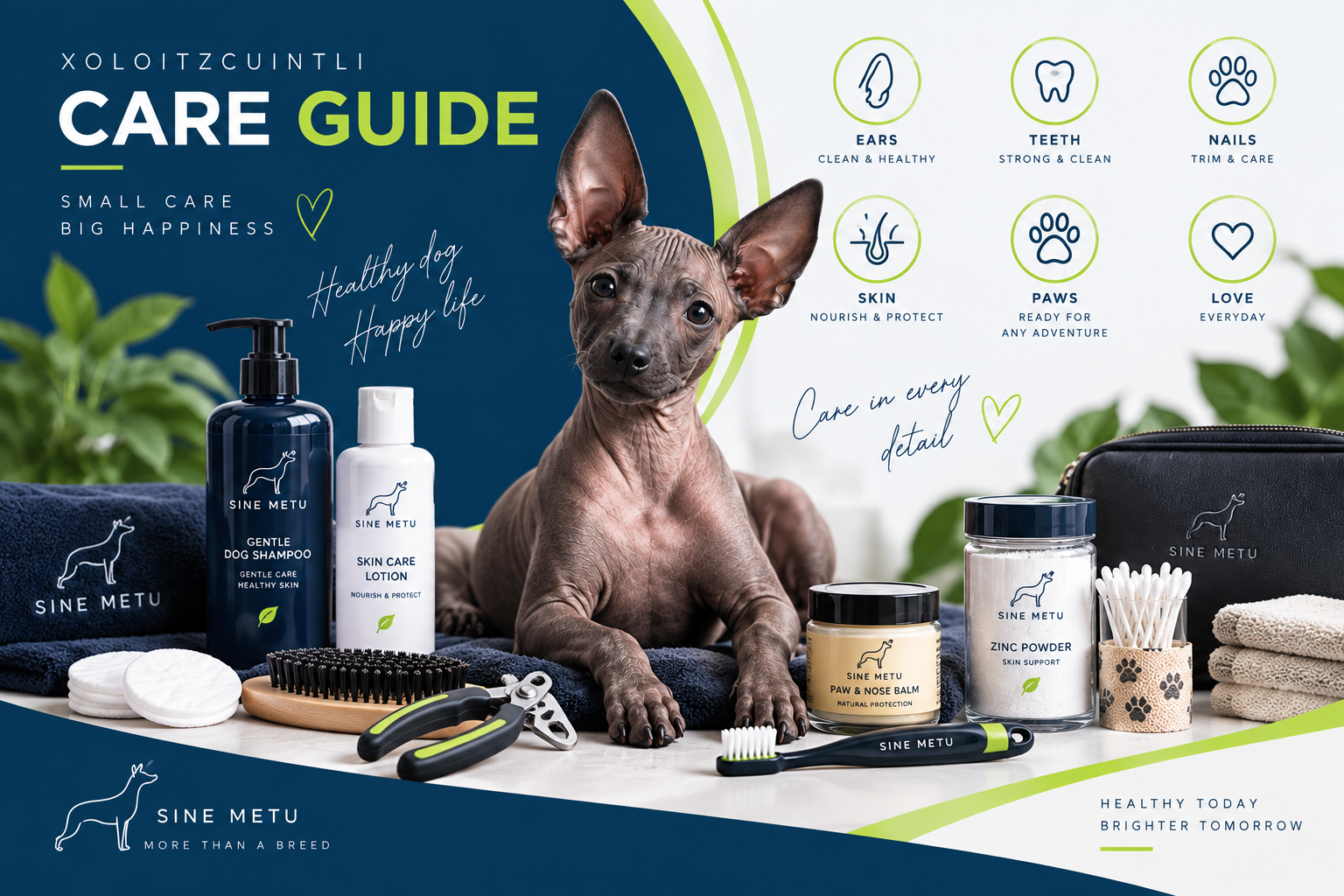
This guide explains the practical approach we use when caring for Xoloitzcuintli.
Usually, no.
Xoloitzcuintli ears generally do not require frequent cleaning. Unlike some breeds that accumulate large amounts of wax or debris, a healthy Xolo may need very little ear maintenance.
The best approach is to check the ears regularly rather than automatically cleaning them on a fixed schedule.
For many Xolos, an occasional cleaning — approximately once a month or even less frequently — may be enough if the ears remain clean and healthy.
Over-cleaning can be unnecessary and may irritate the ear.
This is particularly important for owners who are accustomed to caring for other animals and assume that the ears of a hairless dog should be cleaned frequently.
When the ears actually need cleaning, use a product specifically intended for dogs.
A gentle ear-cleaning lotion can be applied according to the product instructions. The accessible part of the ear can then be cleaned carefully.
The goal is not to clean as deeply as possible.
You should never aggressively insert cotton swabs or other objects deep into the ear canal.
For routine external cleaning, gentle handling is enough.
The book's practical approach is simple: use an appropriate ear lotion or oil, apply it to the ear, and gently clean the accessible area with cotton wrapped around a finger. Deep intervention is not necessary.
The tips of a Xolo's ears deserve special attention.
Because they have little or no hair protection, the skin on the ear tips can become dry, particularly during cold weather.
Dry ear tips may develop:
A suitable dog-safe balm, cream or other moisturizing product can be used when the ear tips become dry.
This is especially useful during winter.
The important principle is simple: moisturize when the skin needs it rather than covering the ears with heavy products all the time.
The book specifically notes that the ear tips can be prone to drying and recommends moisturizing them with a suitable balm, cream or natural oil when needed.
Cold weather can be harder on hairless Xolo skin.
The ear tips, paws and tail are among the areas that can become particularly dry or cracked during freezing weather.
In winter, inspect the ear tips more frequently.
If they become dry, a richer protective cream may be appropriate.
However, there is no reason to use heavy products on healthy skin simply because it is winter. The product should respond to the condition of the skin.
Xoloitzcuintli are sometimes compared with Sphynx cats because both can be hairless.
Their skin care should not be treated as identical.
Sphynx cats generally have much oilier skin and often require considerably more cleaning. A Xoloitzcuintli has different skin characteristics and typically does not have the same level of oiliness.
Therefore, Sphynx grooming routines should not simply be transferred to a Xoloitzcuintli.
This is one reason why excessive cleaning can become a problem for new Xolo owners.
One of the most important differences between caring for an adult Xolo and raising a puppy is ear development.
Xoloitzcuintli puppies may have ears that stand beautifully one day and suddenly fall the next.
This can be completely normal.
During puppy growth, cartilage and supporting tissues are still developing, and the ears may temporarily become weaker.
The book recommends beginning or continuing ear posting during puppyhood, with approximately the first six months being an important period for establishing the desired ear position.
If a puppy arrives in its new home at around three or four months of age, the new owner may need to continue the process started by the breeder.
For Miniature Xoloitzcuintli, the method described in the book is deliberately simple.
You do not need complicated constructions or to wrap the entire ear.
The basic idea is:
The book specifically mentions 3M™ Transpore™, a transparent porous surgical tape, as an example of tape used for temporary support. The tape should be comfortable, allow appropriate ventilation and should not cause irritation.
If the ear is standing after removal, leave it unsupported and observe it.
If it falls again after several days, it can be supported again.
The process may need to be repeated until the ears remain stable on their own.
Do not panic.
Falling ears do not automatically mean that something is wrong.
During growth, ears can change from standing to falling and back again.
This is exactly why consistency matters more than trying to force the ears into position with complicated techniques.
If the skin becomes irritated by the tape, stop and allow the skin to recover. The comfort of the puppy is more important than keeping the ears taped continuously.
If there is persistent irritation, wounds, swelling or another unusual problem, consult your veterinarian.
Usually, additional supplements specifically marketed as being “for ears” are not necessary.
The book specifically notes that supplements such as chondroitin or other products promoted specifically for ear support are generally unnecessary for this purpose.
A puppy needs an appropriate overall diet and normal growth — not a collection of supplements simply because its ears temporarily fall.
Nail trimming is another essential part of Xoloitzcuintli grooming.
How quickly a dog's nails grow varies between individuals.
Some dogs naturally wear their nails down more than others, depending on how much they walk and what surfaces they walk on.
However, natural wear does not always keep every nail at an appropriate length.
Long nails can affect:
For this reason, nails should be checked regularly and trimmed when necessary.
Use an appropriate dog nail clipper or nail grinder.
If you are using clippers, remove small amounts at a time rather than trying to cut a large section in one movement.
The most important thing is to avoid cutting into the quick — the blood vessel and sensitive tissue inside the nail.
If your Xolo has dark nails, identifying the quick can be more difficult. In that case, cutting very small amounts at a time is safer.
If you are uncomfortable trimming the nails yourself, a groomer or veterinarian can show you the correct technique.
It happens.
Even experienced owners can occasionally cut a nail too short.
If the nail starts bleeding, remain calm and use an appropriate styptic or blood-stopping product.
The book notes that bleeding can look dramatic but usually stops relatively quickly and is not generally a serious danger to the puppy.
Afterward, give the dog a calm experience rather than turning nail trimming into something frightening.
Dental care deserves much more attention than many new Xolo owners expect.
Hairless Xoloitzcuintli can have genetic variations in the number and condition of their teeth, and dental care is therefore an important part of maintaining their overall health.
Regular brushing helps reduce plaque accumulation and supports healthier gums.
The practical routine described in the book is:
brush the teeth 2–3 times per week, or more frequently if possible.
Use:
Do not use human toothpaste.
A finger brush can be particularly convenient with a small Xolo because it allows gentle, controlled movements.
The goal is not to perform a perfect dental cleaning on the first attempt.
The first goal is to teach the dog that tooth brushing is a normal part of life.
Start gradually.
First, allow the puppy to become comfortable with having its mouth and lips touched.
Then introduce the toothbrush.
After that, begin brushing a few teeth at a time.
Keep the sessions short and calm.
A cooperative dog that accepts dental care several times a week is much easier to maintain than a dog that has learned to fight every grooming procedure.
The book emphasizes that a calm, gradual process is more important than trying to clean everything perfectly from the beginning.
Pay particular attention to the gum line.
Plaque commonly accumulates around the junction between the teeth and gums.
Brushing should be gentle and without excessive pressure.
Regular oral inspection is also useful, and periodic veterinary dental examinations are recommended.
Paws are another area worth checking regularly, especially in hairless dogs living in cold climates.
Inspect:
In winter, cold, ice and dry surfaces can contribute to paw dryness.
If the paw pads become dry or cracked, a suitable dog-safe protective balm may help.
After walks in areas treated with salt or other de-icing products, paws should be cleaned appropriately.
The tail is another area that can become dry in cold weather.
The same principle applies as with the ear tips: observe the skin and respond to its condition.
Healthy skin does not need to be covered in layers of cream every day.
If the skin becomes dry or irritated, appropriate protection may be useful.
Good hygiene starts long before the first nail trimming or ear cleaning.
A Xolo puppy should gradually learn that people may:
This is especially important because grooming is not an occasional event. It is part of living with the dog.
The calmer the dog becomes about handling during puppyhood, the easier its entire adult care routine will be.
There is no need to turn grooming into a daily ritual.
A practical routine can look like this:
Normal maintenance should not be confused with treatment.
Contact your veterinarian if you notice:
The purpose of routine grooming is to maintain health and notice problems early — not to replace veterinary care.
The Xoloitzcuintli does not need aggressive grooming.
The goal is not to clean everything as often as possible.
The goal is to keep the dog clean, comfortable and healthy while respecting its natural skin and body.
For most Xolos, good care means:
less unnecessary intervention + regular observation + gentle maintenance + correct handling.
That approach is particularly important for a hairless breed whose skin is visible and therefore easy to over-manage.
A well-cared-for Xolo should not look as though it is constantly being treated.
It should simply look healthy.
Ears
Puppy ears
Nails
Teeth
Paws
General care

Is a mono-breed Miniature Xolo kennel.
We know everything about the Xolo breeding and even more.
We choose only the best Xolo bloodlines in the world for the breeding purpose in our kennel.
Our graduates live in more than 15 countries in Europe, the USA and Canada.
All our breeding dogs get tested for genetic diseases and are in excellent health condition.


