June 10, 2022
Feeding a Xoloitzcuintli is not simply about filling a bowl twice a day.
Nutrition influences growth, muscle development, body condition, energy, digestion and, indirectly, the way a dog looks and feels. For a breed such as the Xoloitzcuintli, which has a distinctive metabolism, body structure and skin, it is particularly important to develop a consistent feeding system rather than constantly changing foods in search of something “better.”
At Sine Metu, we have developed our approach through years of breeding, raising puppies and observing adult dogs in our own home, as well as through feedback from owners of our puppies living in different countries.
There is no single diet that is perfect for every Xoloitzcuintli.
A puppy, a young adult, a senior, a pregnant female and a highly active show dog do not necessarily have the same nutritional requirements. A healthy dog with a stable body condition is also very different from a dog with allergies, digestive problems or another medical condition.
So the goal is not to find the most complicated diet.
The goal is to find a complete, appropriate and sustainable feeding system that works for the individual dog.
The first months of a Xolo's life are especially important.
During this period, the puppy is growing rapidly, developing its skeleton and muscles, adapting to its new environment and building the foundation for adult life.
When a puppy comes to a new home, our recommendation is not to immediately experiment with different foods.
A stable routine is much more useful.
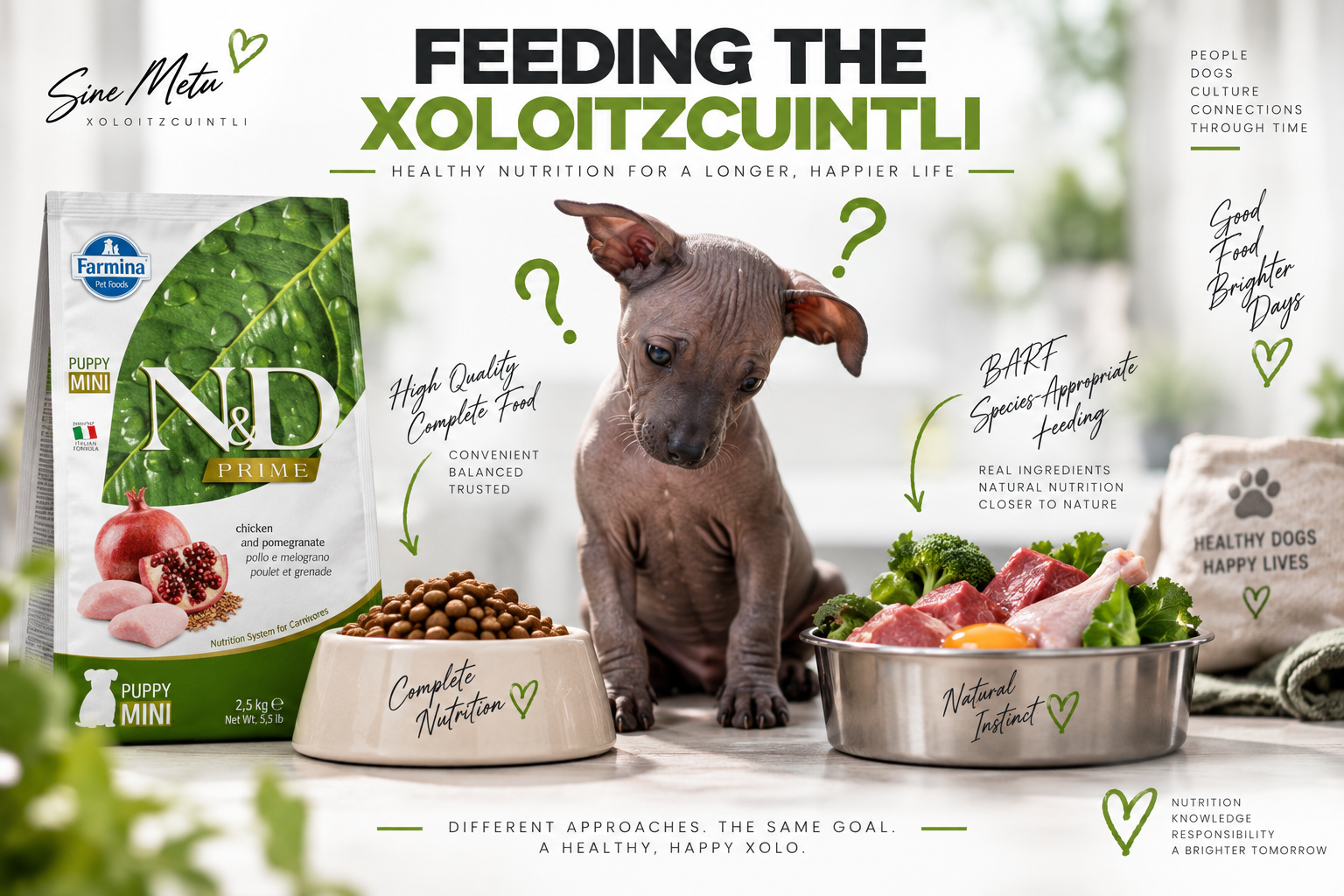
At Sine Metu, we traditionally recommend beginning with a complete puppy diet. For puppies, dry food can be softened with cool or warm water until it becomes fully hydrated. This can make the transition easier while keeping the nutritional composition of the complete food controlled. This approach is also described in our own feeding guide.
Based on our own experience, Farmina N&D is one of the foods we have found particularly successful for Xoloitzcuintli puppies, including the N&D formulas designed for small-breed puppies. We have used this approach for years and have seen consistent results in growth and development.
The important point is that the food should be appropriate for the puppy's life stage.
A puppy should not simply receive an adult maintenance food because the ingredients appear attractive on the label.
Young puppies usually need several meals throughout the day.
In our practical system, puppies are commonly fed three to four times a day during the growth period, with the exact schedule adjusted as the puppy matures.
The feeding amount printed on a food package is generally a daily amount, not an amount for every meal.
For example, if the recommended daily quantity is 60 g, that does not mean 60 g at each feeding. The daily amount should be divided between the meals.
Our book also emphasizes that the manufacturer's feeding recommendation is only a starting point. The puppy itself must be observed: body condition, growth, appetite, digestion and general development are more informative than blindly following a number on a package.
A growing Xolo should be developing steadily without becoming excessively thin or excessively heavy.
One of the easiest mistakes is to judge a puppy only by weight.
Two puppies of the same age can have different body structures, activity levels and growth rates.
A much more useful question is:
Does this puppy look and feel appropriately developed for its age?
The ribs should not be hidden under excessive fat, but neither should the puppy look chronically underfed. The abdomen, muscles, coat, skin, stool quality, appetite and energy level all provide useful information.
The food package is a guide.
The dog is the final reference.
In our practical experience, a Miniature Xoloitzcuintli can begin the transition toward adult nutrition at approximately nine months of age, provided the puppy's development is appropriate.
The transition should be gradual rather than abrupt.
However, this should not be treated as a universal deadline. Individual development varies, and puppies, juniors and adults have different nutritional requirements.
A veterinarian can also recommend a different transition schedule if there is a specific health, growth or reproductive consideration.
Nutrition is one of the areas where our recommendation is very practical.
At Sine Metu, our primary feeding system is based on complete Farmina N&D diets.
This is not because we believe that one brand is automatically perfect for every dog.
It is because we have accumulated years of practical experience with these foods, both in our own dogs and through feedback from people who have taken Sine Metu puppies into their homes.
Farmina's N&D range includes different formulas for different life stages and sizes, so it is important to choose the appropriate formula rather than treating “N&D” as one single food.
For example, current official Farmina formulas for small adult dogs have different analytical compositions depending on the recipe. One N&D Adult Mini formula lists 30% crude protein and 18% fat, while another formula has a different composition.
That is exactly why reading the analytical composition of the specific food matters.
If someone asks me personally which commercial food I would recommend for a Xoloitzcuintli, my answer comes from experience rather than advertising.
Today, based on my own experience and the experience of Sine Metu dog owners, Farmina N&D is one of the best foods I have found for our dogs.
I value it because I have seen good practical results with it over many years.
For me, the important indicators are not whether a package looks impressive or whether a particular ingredient sounds fashionable.
I look at the dog.
Is the dog maintaining good muscle condition?
Does it have stable energy?
Is digestion good?
Is the stool appropriate?
Does the dog maintain good body condition?
How does the skin look?
Does the dog continue to eat the food willingly?
How does the dog respond over time?
These observations matter more to me than constantly changing food because a new product has appeared on the market.
A feeding system that works consistently is often more valuable than an endless search for something supposedly better.
When evaluating dry food for an adult Xoloitzcuintli, we pay particular attention to the analytical composition.
For a healthy young adult Xolo, our practical reference is approximately:
Our original feeding guide describes these values as a practical reference for adult Xolos and also notes that fiber should generally remain moderate rather than excessive.
This is an important clarification:
It is a Sine Metu practical reference for a healthy young adult dog.
A puppy requires a growth-appropriate diet.
A junior dog may have different requirements.
A senior dog may need a different nutritional profile.
A pregnant or nursing female has different energy and nutrient requirements.
A dog with a medical condition may require a therapeutic diet.
And a veterinarian may recommend adjustments for an individual dog.
So the numbers should help you understand how we evaluate food — not replace individual nutritional assessment.
Modern veterinary nutrition also emphasizes individualized feeding based on life stage, body condition, muscle condition and health status rather than applying one formula to every dog.
There is no single number that applies to every Xolo.
The appropriate quantity depends on:
Two Xolos weighing the same amount can need different quantities of food.
This is why we prefer to use the feeding recommendation on the package as a starting point, then adjust according to the individual dog.
If a dog is becoming too thin, the amount may need to increase.
If the dog is gaining unnecessary fat, the amount may need to decrease.
The goal is not to feed the largest possible portion.
The goal is to maintain the correct body condition.
A Xoloitzcuintli does not necessarily need exactly the same amount of food throughout the year.
Seasonal changes can affect:
In cold weather, maintaining body temperature requires energy. A dog that spends a lot of time outdoors in winter may therefore need more energy than during a warm period.
But this does not mean that every Xolo should automatically receive more food as soon as winter arrives.
The dog's condition and activity should determine the adjustment.
Hairless dogs have a particularly interesting relationship with temperature.
The body must maintain its core temperature even when the environment becomes cold.
A dog that is active outdoors in cold weather may therefore expend more energy.
This is especially relevant for Xolos living in climates with cold winters.
But the answer is not simply:
“It is winter, so give more food.”
Instead, observe the dog.
If activity increases and the dog begins losing condition, additional calories may be appropriate.
If the dog spends most of winter indoors and becomes less active, increasing food may actually lead to unnecessary weight gain.
During hot weather, many dogs naturally reduce activity.
Long walks may become shorter.
Running may decrease.
The dog may spend more time resting.
As a result, calorie requirements can sometimes decrease.
At the same time, hydration becomes particularly important.
During summer, the feeding system should therefore be adapted to the dog's actual activity rather than the calendar alone.
Some Xolos are excellent eaters.
Others are selective.
And some seem to believe that they are permanently starving.
A dog asking for food does not automatically mean that it needs more food.
Begging, especially when reinforced repeatedly, can become a habit.
If the dog's body condition is good and the diet is nutritionally appropriate, constantly increasing the amount because the dog asks for more is usually not a good strategy.
A healthy feeding system includes boundaries.
Another common mistake is constantly changing food.
A dog eats one food for two weeks.
Then someone recommends another.
Then a social-media post suggests something else.
Then a new supplement is added.
Then a different protein is introduced.
Eventually, if digestion or skin changes, it becomes difficult to understand what caused the reaction.
If a food works well, there is usually no reason to change it simply because another product exists.
Consistency makes observation easier.
Fresh drinking water should always be available.
This becomes especially important during:
A dog should not have to wait for a meal to receive water.
Treats are useful for training, socialization and everyday interaction.
But they should remain a small part of the overall diet.
At Sine Metu, natural treats may include things such as small amounts of suitable vegetables, fruits or properly prepared animal products.
Our book also describes dried meat, liver and lungs as occasional natural treats or rewards rather than replacements for the main diet.
The principle is simple:
Treats should complement the diet, not quietly replace it.
If a dog receives large quantities of treats every day, the nutritional balance of the main diet becomes less meaningful.
A Xoloitzcuintli can also be fed a natural, home-prepared diet.
There is nothing inherently wrong with the idea of preparing food at home.
The problem is that “natural” does not automatically mean “complete.”
Meat alone is not a complete diet.
Meat plus vegetables is not automatically a complete diet.
Changing ingredients every few days does not guarantee nutritional balance.
A properly formulated home-prepared diet needs to provide the correct amounts and ratios of protein, fat, essential amino acids, fatty acids, vitamins and minerals.
Veterinary nutrition organizations warn that many home-prepared recipes — including recipes published in books and online, and even some written by veterinarians — are not nutritionally complete and balanced. For owners who choose home preparation, consultation with a veterinary nutritionist is recommended.
This is particularly important for puppies.
A nutritional imbalance during growth can have much more serious consequences than an imperfect diet given briefly to a healthy adult.
It is possible to use natural foods as additions to a complete commercial diet.
For example, a small amount of cooked meat, vegetables or another suitable food may be used as an addition or reward.
But there is an important distinction between:
adding a small amount of food
and
replacing a significant part of a complete diet.
If a substantial portion of the daily calories comes from homemade food, the entire diet needs to be considered nutritionally.
Otherwise, the “complete” commercial food may no longer represent the complete nutritional intake.
BARF is one of the most discussed alternative feeding systems for dogs.
The term is commonly used for Biologically Appropriate Raw Food or Bones and Raw Food.
The philosophy is based on feeding raw animal products and attempting to approximate what advocates consider a more natural or evolutionary diet.
For some owners, BARF is a carefully planned feeding system.
For others, it becomes simply “give the dog raw meat.”
Those are not the same thing.
The modern raw-feeding movement is strongly associated with the work of Ian Billinghurst, whose books Give Your Dog a Bone and The BARF Diet helped popularize the concept of evolutionary raw feeding.
The underlying idea is understandable:
dogs evolved eating animal foods, so perhaps feeding minimally processed animal foods is more appropriate.
It is an interesting nutritional philosophy.
But the existence of an evolutionary argument does not automatically prove that a raw diet is healthier than a properly formulated complete commercial or cooked diet.
Current veterinary nutrition guidance does not find evidence that raw meat-based diets provide health benefits over commercial diets or balanced homemade cooked diets.
The biggest mistake with BARF is thinking that it is simple.
A nutritionally complete raw diet requires knowledge of:
Simply feeding muscle meat, bones and some organs does not guarantee nutritional completeness.
This is especially important for growing puppies.
There is another important issue: microbiological safety.
Raw animal products can contain pathogenic bacteria and other microorganisms.
AAHA does not advocate feeding raw or nonsterilized animal-source diets because of the risk of pathogen transmission to pets, people and other animals.
WSAVA likewise states that there is no evidence that raw meat-based diets provide health benefits over commercial or balanced homemade cooked diets, while there is growing evidence of health risks associated with raw feeding.
This does not mean that every dog fed raw food will become ill.
It means that the risk exists and should not be ignored.
The risk is particularly relevant in households with young children, elderly people or immunocompromised individuals.
If someone wants to feed a home-prepared diet, there are different approaches.
One owner may prefer carefully formulated cooked food.
Another may choose BARF.
The important thing is not to confuse personal preference with scientific certainty.
BARF can be a feeding philosophy, but it should not be presented as a scientifically proven superior diet.
Likewise, homemade cooked food can be an excellent option if it is properly formulated.
The nutritional quality of the finished diet matters more than whether the ingredients were cooked or raw.
This brings us back to the reason we use Farmina N&D as our primary feeding system.
For us, the biggest advantage is control and consistency.
A complete commercial diet is formulated to provide the nutrients required for its intended life stage.
That makes it much easier to maintain a stable feeding system for a breeding kennel with puppies, young dogs and adults.
It also makes it easier for our puppy owners to continue the same nutritional approach after their puppy leaves us.
And, importantly, we can observe the dogs over time.
We are not choosing food because it is fashionable.
We choose what has given us good practical results.
The Xolo's skin is one of the most visible indicators of overall condition.
Changes in skin quality can have many causes, including genetics, environment, parasites, allergies, hormones and nutrition.
This is why we do not automatically assume that every skin change is caused by food.
However, if a dog develops persistent digestive problems, itching, changes in skin condition or other abnormalities after a dietary change, the diet should be considered as one possible factor.
This is another reason not to change several things simultaneously.
If you change food, treats, supplements and shampoo all at once, it becomes much harder to identify what actually affected the dog.
The pet-food market is full of new products.
There are new proteins.
New ingredients.
New supplements.
New philosophies.
New claims.
But a dog does not need a new diet every month.
If your Xolo has:
and is thriving on a complete diet, there may be no reason to change it.
Sometimes the best feeding decision is simply to stop changing things that work.
Of course, there are times when a change is appropriate.
A diet may need to change when:
The important thing is to change the system for a reason.
Not because someone on the internet said that every dog should eat something different.
After years of working with Xoloitzcuintli, our approach can be summarized quite simply.
We prefer:
A complete and appropriate diet.
Stable feeding routines.
Good-quality ingredients and reliable formulations.
Observation of the individual dog.
Appropriate nutrition for each life stage.
Moderate use of treats.
Constant access to fresh water.
Careful consideration before changing food.
And, for our own dogs, Farmina N&D remains one of our preferred feeding systems based on our practical experience.
Watch activity as it increases after winter.
Adjust food if the dog's energy expenditure changes significantly.
Keep water available at all times.
Monitor appetite and activity.
Do not force the dog to eat the same amount simply because the winter portion was larger.
As temperatures fall and activity changes, reassess body condition.
If the dog spends significant time outdoors and burns more energy maintaining body temperature, additional calories may become appropriate.
But once again, let the dog guide the adjustment.
There is no magic ingredient that makes a Xoloitzcuintli healthy.
There is no single protein percentage that is perfect for every dog.
There is no universal feeding schedule.
There is no scientifically established reason why every Xolo should eat BARF.
And there is no reason to believe that the most complicated diet is automatically the best.
Good nutrition is much simpler than that.
Feed the correct diet for the dog's life stage.
Choose a nutritionally complete food or formulate homemade food properly.
Watch the dog's body condition.
Adjust according to activity and season.
Do not overfeed because the dog begs.
Do not constantly change food without a reason.
And seek veterinary or veterinary-nutrition guidance when the individual dog requires something different.
At Sine Metu, our practical experience has led us to a straightforward system: complete nutrition, consistency, observation and Farmina N&D as one of our preferred foods.
Because ultimately, the best diet is not the one that sounds most impressive.
It is the one that allows your individual Xoloitzcuintli to grow, maintain good condition, feel well and live a healthy, active life.

Is a mono-breed Miniature Xolo kennel.
We know everything about the Xolo breeding and even more.
We choose only the best Xolo bloodlines in the world for the breeding purpose in our kennel.
Our graduates live in more than 15 countries in Europe, the USA and Canada.
All our breeding dogs get tested for genetic diseases and are in excellent health condition.


