June 10, 2022
Good health is not only about treating a dog when something goes wrong.
For a Xoloitzcuintli, responsible health care means regularly checking the things that can change quietly over time: body condition, teeth, parasite exposure, vaccination status, general physical condition and, when appropriate, laboratory results.
At Sine Metu, we believe that preventive care should be individual, practical and based on the dog's age, lifestyle and real risks.
A healthy young Xolo does not need every possible diagnostic test simply because it is available. At the same time, an older dog may benefit from more frequent examinations and laboratory screening.
The goal is not to test everything.
The goal is to notice changes early and prevent avoidable problems.
The World Small Animal Veterinary Association (WSAVA) recommends that dogs receive a veterinary check-up at least once a year, with more frequent examinations for very young, older or medically complex animals.
For a healthy adult Xoloitzcuintli, an annual veterinary examination is an important minimum.
The veterinarian should not simply vaccinate the dog and send it home.
A proper wellness examination should include a general physical assessment, including:
WSAVA's current wellness principles specifically include assessment of weight, body condition, muscle condition, nutrition and oral health as part of the routine clinical examination.
For a healthy young adult Xolo, once a year is usually a sensible routine.
As dogs become older, the interval should become shorter. AAHA recommends that senior dogs are examined approximately every six months, even when they appear healthy.
Vaccination is one of the most important parts of preventive health care, but modern vaccination guidelines are more sophisticated than simply giving the same injection every year.
The current WSAVA guidelines divide vaccines into core and non-core vaccines.
For puppies, WSAVA recommends starting core vaccination against canine distemper virus (CDV), canine adenovirus (CAV) and canine parvovirus (CPV) at approximately 6–8 weeks of age, then repeating every 2–4 weeks until 16 weeks of age or older. The dose given at 16 weeks or later is particularly important because maternal antibodies should have declined substantially by that age.
After the puppy vaccination series is completed, the approach changes.
For the major core modified-live vaccines protecting against distemper, adenovirus and parvovirus, WSAVA supports revaccination no more frequently than every three years in properly vaccinated adult dogs.
This does not mean that a dog should simply ignore vaccination for three years.
Every year, the veterinarian should review the dog's vaccination status and lifestyle.
Some vaccines require more frequent protection. For example, WSAVA considers leptospirosis a core vaccine in regions where canine leptospirosis is prevalent, relevant serogroups are known and suitable vaccines are available. Because leptospirosis vaccines generally provide shorter protection, they are commonly administered annually.
Rabies is different again because vaccination intervals can be determined by local legislation and the licensed duration of immunity of the specific vaccine.
So our principle is simple:
Annual veterinary review does not automatically mean every vaccine must be given every year.
The vaccination plan should be based on the dog's age, previous vaccination history, geographic location, travel, lifestyle, disease risk and the vaccine manufacturer's licensed duration of immunity.
Parasite prevention is another area where old-fashioned “give a worming tablet every three months” advice is too simplistic.
The current European approach is based much more strongly on individual risk assessment.
ESCCAP recommends considering factors such as:
Puppies are treated more frequently than adult dogs.
The current ESCCAP scheme recommends treatment against roundworms from two weeks of age, then every 14 days until two weeks after weaning, followed by monthly treatment until six months of age.
This is one reason puppy parasite prevention cannot simply follow an adult dog's schedule.
For adult dogs, the frequency depends on risk.
ESCCAP's current individual scheme includes:
Importantly, ESCCAP specifically states that if individual risk cannot be assessed clearly, the dog should be examined or treated at least four times per year, and that treating only 1–3 times annually may not provide sufficient protection.
Therefore, there is no scientifically correct universal rule saying:
“Every Xolo must be dewormed every month.”
Nor is there a universal rule saying:
“Every adult dog only needs deworming once every three months.”
The correct interval depends on the parasite risk.
For some dogs, regular fecal examinations can be used instead of routine treatment. This should be discussed with the veterinarian.
This is where preventive medicine should remain sensible.
A completely healthy young Xolo with a normal physical examination does not necessarily need a large laboratory panel every few months.
At the same time, bloodwork becomes increasingly useful as a dog matures.
AAHA life-stage recommendations suggest that for a young adult dog, a baseline CBC, chemistry panel and urinalysis can be considered. For mature adult dogs, routine bloodwork becomes more appropriate, and for senior dogs, testing is recommended more frequently.
For senior dogs, current AAHA recommendations include:
CBC, chemistry and urinalysis are generally recommended every 6–12 months in senior dogs.
So a practical Xolo approach can look like this:
Young healthy adult:
annual examination, with baseline bloodwork considered according to the veterinarian's assessment.
Mature adult:
annual wellness examination and increasingly regular laboratory screening.
Senior Xolo:
veterinary examination approximately every six months, with CBC, chemistry and urinalysis commonly performed every 6–12 months.
And, of course, blood tests should be performed at any age when there are clinical signs, unexplained weight change, appetite changes, vomiting, diarrhea, excessive thirst or urination, lethargy, medication monitoring, or another medical reason.
We never judge a Xolo's health only by kilograms.
Two dogs of exactly the same height can have very different healthy weights.
What matters is body condition.
WSAVA's 9-point Body Condition Score considers 4–5/9 to be the ideal range for most dogs. At approximately 5/9, the ribs should be palpable without excessive fat covering, the waist should be visible behind the ribs when viewed from above, and the abdomen should tuck upward when viewed from the side.
This is very close to the practical way we assess our Xolos.
A healthy Xolo should not be covered with a thick layer of fat.
You should be able to easily feel the ribs with your fingers. On a lean, healthy Xolo, individual ribs may be subtly visible depending on posture, movement and breathing. They should not be hidden under a heavy fat layer.
At the same time, the dog should not look skeletal.
The waist should be visible, the abdomen should tuck upward, and there should be good muscle condition.
For a Xolo, we want to see a lean, athletic body — not an underweight body and not an overweight one.
This deserves special attention.
The Xoloitzcuintli is unusual because the hairless phenotype is genetically connected with dental development.
Research has identified a mutation in the FOXI3 gene associated with the hairless phenotype and characteristic dental abnormalities. Hairless dogs can have missing permanent teeth and changes in tooth morphology.
This means that a hairless Xolo may have a significantly different dentition from a coated dog.
The number and shape of teeth can vary, and some teeth may be absent.
This is not automatically a disease.
It is part of the biology of the hairless Xolo.
However, unusual dentition makes regular oral care particularly important.
The main concerns are not simply “having fewer teeth.”
We need to watch for:
There is an important distinction here: we should not claim that fewer teeth automatically cause dental caries. The stronger evidence is for altered dentition and increased attention to periodontal and dental health, not that Xolos are inherently prone to cavities simply because they have fewer teeth.
Daily home care is the foundation.
The Veterinary Oral Health Council and AAHA recommend regular toothbrushing, ideally daily, because plaque begins accumulating soon after eating.
Use:
Human toothpaste should not be used.
But brushing alone does not replace professional dental examinations.
AAHA recommends a professional veterinary dental examination at least annually, while the frequency of professional cleaning depends on the individual dog's oral health. Small dogs and dogs with higher dental risk may require more frequent professional care.
For our Xolos, we consider a practical schedule of a dental examination every 6–12 months, with professional cleaning when tartar and periodontal disease require it.
A dog that develops tartar quickly may need professional cleaning more often than once a year.
A dog with excellent home dental care may need less frequent professional intervention.
The important thing is not to wait until the mouth is painful.
A proper veterinary dental procedure is more than scraping visible tartar from the front of the teeth.
Dental disease can exist below the gumline where owners cannot see it.
A complete professional dental procedure may include an examination under anesthesia, periodontal probing, dental radiographs and cleaning below the gumline when indicated.
This is especially important for Xolos with unusual or missing teeth.
A missing tooth on the surface does not tell us everything about what is happening beneath the gum.
If there is persistent bad breath, red or bleeding gums, difficulty chewing, drooling, loose teeth, facial swelling or changes in eating behavior, the dog should be examined rather than simply given another dental chew.
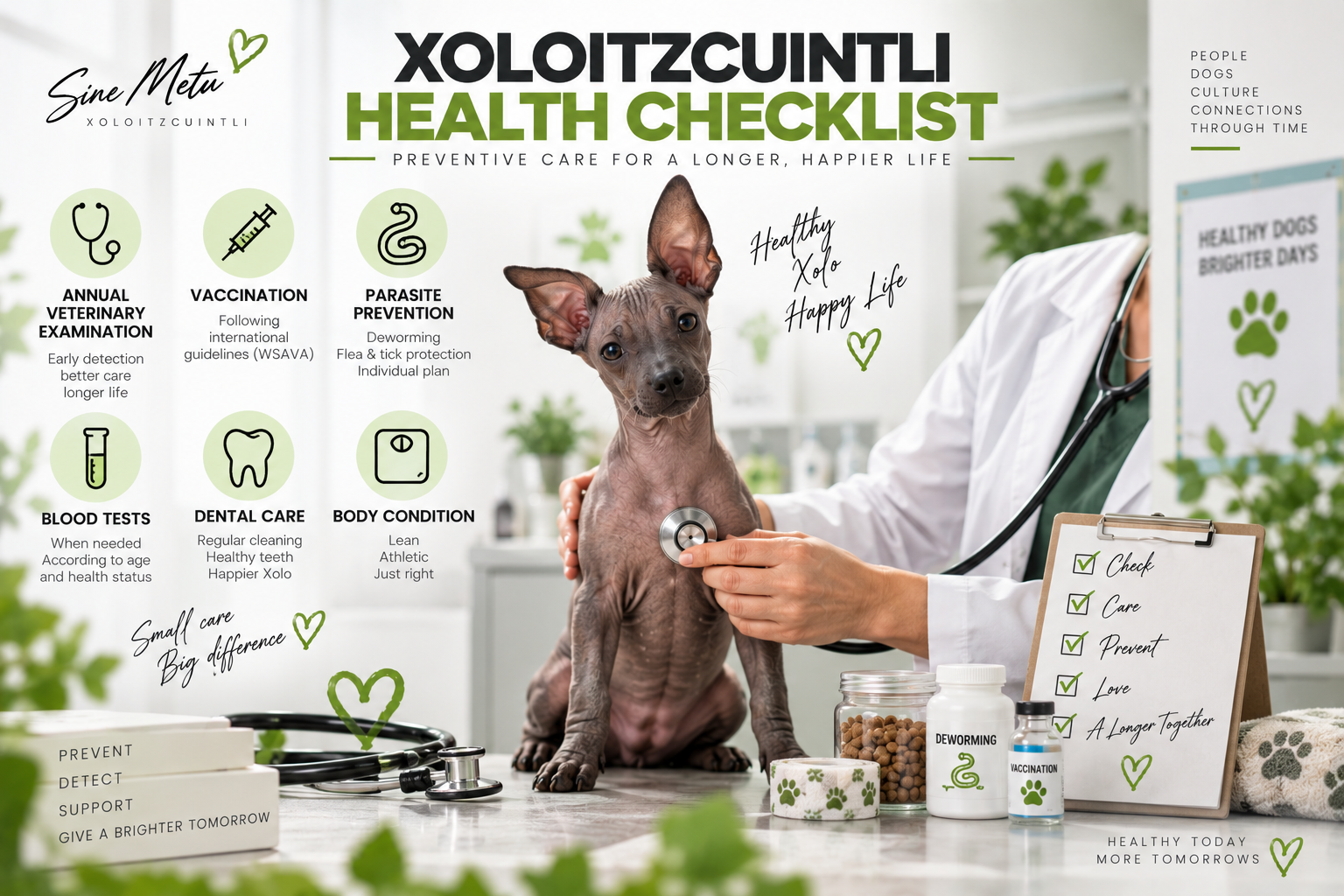
For a healthy adult Xoloitzcuintli, our preventive-care checklist is straightforward.
Veterinary examination
Vaccination
Parasite prevention
Dental care
Bloodwork
A good health plan should evolve with the dog.
A young Xolo does not need the same monitoring as a ten-year-old Xolo.
With age, we become more interested in:
AAHA recommends senior dogs be examined approximately every six months, with laboratory testing commonly performed every 6–12 months.
This is where preventive medicine becomes especially valuable.
The purpose of screening is not to find something wrong with every older dog.
It is to identify small changes before they become large problems.
We do not believe that responsible dog ownership means performing every possible test every year.
We believe in appropriate preventive care.
A healthy Miniature Xoloitzcuintli needs regular veterinary attention, sensible vaccination, parasite control based on real exposure risk, monitoring of body condition and serious attention to dental hygiene.
We also believe that owners should learn to know their own dog.
You should know how your Xolo normally eats, moves, sleeps, breathes, looks and behaves.
You should know how the ribs feel under your hands.
You should notice if the waist disappears.
You should look inside the mouth.
You should recognize when the skin changes.
And you should not wait for a serious symptom before contacting your veterinarian.
Preventive health is not about doing more medicine.
It is about doing the right things at the right time.
For the Xoloitzcuintli, that means keeping the dog lean and fit, protecting against preventable infectious and parasitic diseases, maintaining excellent oral hygiene and having a proper veterinary examination throughout life.
That is how we want our Xolos to age: healthy, active, comfortable and well cared for.
The following veterinary guidelines, scientific publications and professional resources were used when preparing this article:
These sources were used to support the sections on vaccination, parasite prevention, veterinary examinations, body condition, senior preventive care, dental health and the FOXI3-related dental characteristics of hairless Xoloitzcuintli.

Is a mono-breed Miniature Xolo kennel.
We know everything about the Xolo breeding and even more.
We choose only the best Xolo bloodlines in the world for the breeding purpose in our kennel.
Our graduates live in more than 15 countries in Europe, the USA and Canada.
All our breeding dogs get tested for genetic diseases and are in excellent health condition.


