September 6, 2026
Xoloitzcuintli skin care is not about using a large number of products or performing complicated procedures.
It starts with understanding how Xolo skin works and what is normal for the breed.
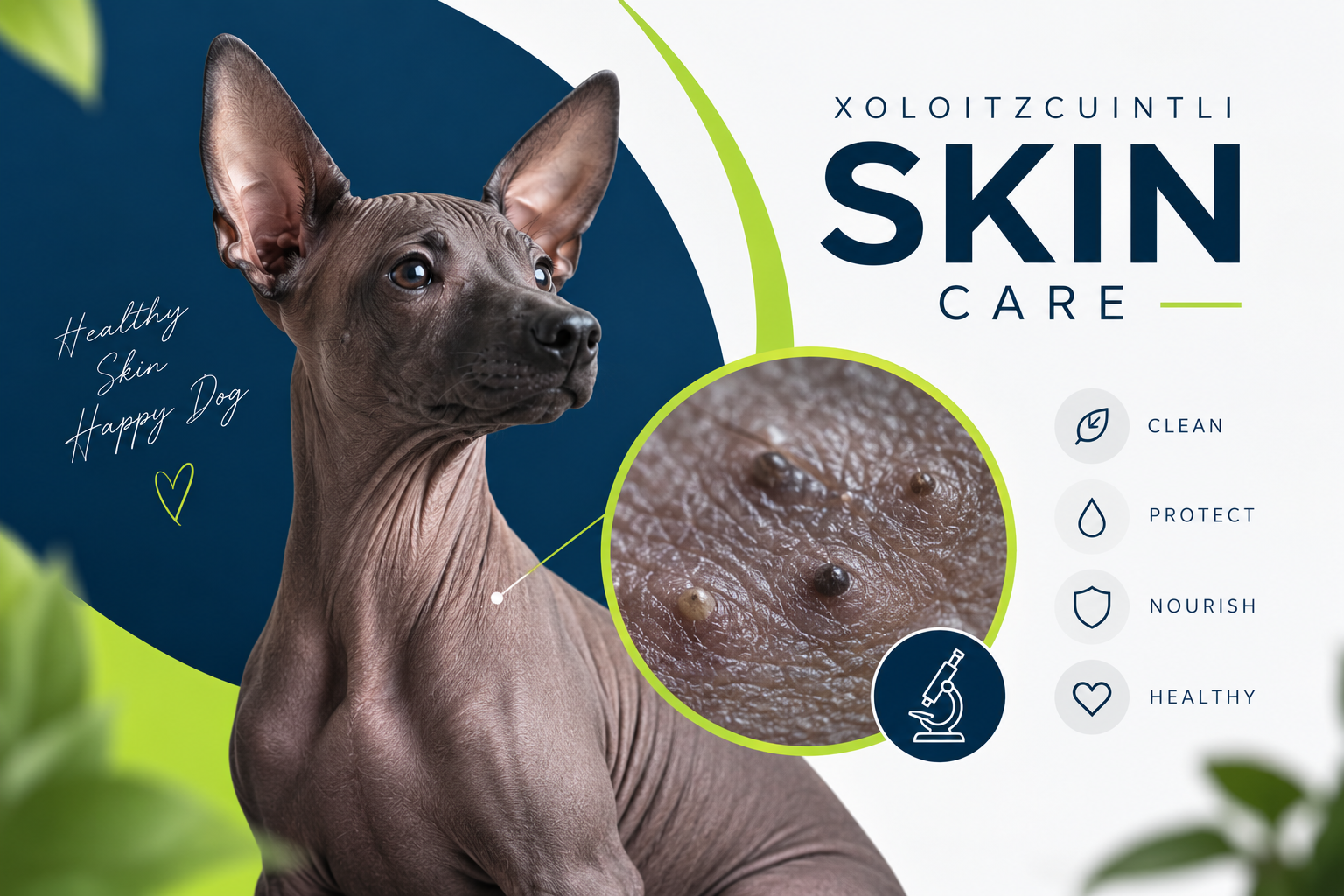
The skin of a hairless Xoloitzcuintli is not simply "skin without hair." It has its own characteristics, including partially developed hair follicles and a natural tendency to develop comedones and occasional acne.
For new Xolo owners, this can sometimes be confusing. A few black dots, small bumps or changes in skin color do not automatically mean that something is wrong.
The key to good Xoloitzcuintli skin care is learning to distinguish normal breed characteristics from genuine skin problems.
Hairless Xoloitzcuintli have partially preserved hair follicles, but these follicles do not function in the same way as normal hair follicles.
Hair may not develop at all or may develop only partially. Because of this, keratin and sebum can accumulate inside the follicles.
This can lead to comedones, which may appear as black dots or small bumps under the skin. Occasionally, a small developing hair can also be visible inside a comedone.
Comedones are not automatically a sign of infection or dirty skin.
They are a natural feature of how hairless Xolo skin functions.
One of the most common misconceptions about hairless dogs is that their skin is naturally very oily.
This is not generally the case with Xoloitzcuintli.
Healthy Xolo skin is usually soft, elastic and relatively clean-looking rather than excessively greasy.
Sebum is produced normally. The problem is often not the amount of sebum, but the fact that it cannot always leave the follicle normally.
As a result, Xolo skin can sometimes look relatively dry while still developing comedones.
This is an important distinction because excessive washing or aggressive degreasing can make the skin worse rather than better.
The most common skin changes owners notice include:
Not all of these conditions have the same cause, and they should not all be treated in the same way.
Comedones are clogged follicles containing sebum and keratin.
They can appear as:
Open comedones can look like blackheads, while closed comedones may look like small pale or skin-colored bumps.
The important thing to understand is that comedones themselves are not an infection.
They are part of the normal physiology of hairless Xolo skin. Problems arise when a clogged follicle becomes inflamed and develops into acne.
Acne occurs when inflammation develops around a clogged follicle.
It can appear as red bumps, pustules or inflamed areas.
The period when acne and other skin changes are most noticeable is often during growth.
In puppies approximately 2–12 months old, hormonal changes can make the skin considerably more unstable.
Comedones, small breakouts and occasional inflammation can appear during this period.
This does not necessarily mean that the puppy has a serious skin disease.
In many cases, these changes decrease significantly or disappear as the dog reaches adulthood.
Young Xolos can develop temporary breakouts, including on the head and muzzle.
These changes can be particularly alarming to a first-time owner because the puppy may suddenly look different from a few weeks earlier.
The important thing is not to start treating every small bump aggressively.
First, determine what you are actually looking at.
A few comedones are not necessarily a problem.
More serious concern is appropriate when there is:
Very severe cases of comedones or acne are uncommon, particularly when skin problems are recognized and managed appropriately.
This is one of the most common questions from Xolo owners.
The answer is: sometimes, but extremely carefully.
If a comedone is already open and its contents come out easily, gentle cleaning may be possible.
However, you should never aggressively squeeze the skin.
Do not:
Aggressive manipulation can cause inflammation and infection.
If a lesion is deep, painful, swollen or inflamed, it is better not to squeeze it.
The basic rule is simple:
Do not damage healthy skin in an attempt to make it look perfectly clean.
Hairless Xoloitzcuintli need regular skin cleaning, but more cleaning does not necessarily mean better skin.
A practical routine is to wash the skin approximately every 5–7 days, using gentle products that do not aggressively dry the skin.
The purpose of washing is to keep the skin clean while preserving its natural balance.
Strong cleansing products can strip the skin and make it excessively dry.
In particular, shampoos containing SLS can be too aggressive for hairless Xolo skin.
A gentler shampoo or cleansing gel without SLS and other harsh ingredients is preferable.
Products formulated for dogs with a pH appropriate for their skin can be used; the approximate pH range discussed for Xolo skin is 6.2–7.4.
The goal is not to remove every trace of natural sebum.
The goal is to keep the skin clean without disrupting its natural balance.
Moisturizing is useful when the skin actually needs it.
It should not automatically become a heavy daily routine for every Xolo.
If the skin becomes significantly dry, a richer cream may be appropriate.
Products containing urea can help retain moisture and improve the feel and condition of dry skin.
However, richer products should be used in response to the condition of the skin rather than automatically applied all the time.
More oil does not necessarily mean healthier skin.
Heavy oils, including mineral oils, can create a film over the skin and interfere with the normal movement of sebum out of the follicles.
This can contribute to more clogged follicles, comedones and inflammation.
For this reason, heavy oils should not be used routinely on Xolo skin simply because the skin appears dry.
Sunlight is one of the most important natural influences on the skin of a hairless Xoloitzcuintli.
Xolos naturally develop a tan during periods of increased sun exposure.
In moderate amounts, sun exposure can improve the appearance and condition of the skin and may reduce inflammatory elements and comedones.
The skin can become dramatically darker during summer.
A bronze or gray Xolo may become so deeply tanned that its original base color can be difficult to recognize.
This is completely natural.
As sunlight decreases, the tan gradually fades.
The change can happen evenly or in patches.
It can sometimes look unattractive, especially while the color is changing, but this is not the skin "peeling off."
The skin is simply returning gradually toward its natural base color.
This seasonal cycle does not normally require treatment.
Sunscreen should not automatically be applied over the entire body of a hairless Xolo.
During normal tanning, unnecessarily covering the whole skin with creams can interfere with the natural process.
An important exception is white or depigmented skin, which may require additional protection from the sun.
Cold weather creates a different set of problems.
During winter, hairless Xolo skin is more susceptible to dryness and cracking, particularly around:
These areas may require richer protective creams during freezing weather.
This is one of the situations where a heavier product can genuinely be useful.
The goal in winter is not to cover the entire dog in heavy products, but to protect the areas that actually need additional support.
One of the most important things for a Xolo owner to learn is how to distinguish normal localized skin changes from a possible allergic reaction.
Comedones and ordinary acne are usually relatively localized.
They may appear as individual black dots or pimples, commonly on the back, sides and sometimes the neck.
They generally do not cause intense itching or suddenly spread across the entire body.
Allergic reactions can look very different.
Possible signs include:
The skin may become noticeably dry, sensitive and rough to the touch.
Food-related reactions may also produce more widespread skin changes and can sometimes appear relatively suddenly.
If an allergic reaction is suspected, the dog's diet and other possible triggers should be evaluated, with veterinary guidance where appropriate.
Not every skin reaction is an allergy.
Hairless Xolos can also develop mechanical irritation from direct contact with clothing or equipment.
Common triggers include:
These materials can rub directly against the skin and cause irritation, redness or even wounds.
If irritation appears exactly where clothing or equipment contacts the skin, the first step is to remove the source of friction.
The clothing should be replaced with something softer and better fitted.
The same principle applies to collars and harnesses.
Despite all of these considerations, Xolo skin should not be treated as extremely fragile.
Healthy Xolo skin is well adapted to normal environmental conditions.
However, even healthy skin can react to constant mechanical friction or inappropriate materials.
Comfort, fit and material quality are therefore an important part of skin care.
Fungal infections can sometimes look similar to allergic or inflammatory skin conditions.
Without experience, it can be difficult to distinguish between them.
Even veterinary professionals may require additional diagnostic testing to identify the cause correctly.
For persistent or unexplained skin lesions, veterinary evaluation is appropriate rather than repeatedly changing cosmetic products.
Not every Xolo skin problem should be managed at home.
Veterinary advice is appropriate when you see:
These signs can indicate that the problem has moved beyond normal breed-related skin changes and requires professional evaluation.
If possible, finding a veterinarian who has experience with Xoloitzcuintli can be particularly valuable.
Xolo skin has breed-specific characteristics, and these can easily be misunderstood if they are approached in exactly the same way as the skin of other breeds.
Another interesting characteristic described in our experience with the breed is the skin's ability to recover after minor injuries.
Xolo skin generally heals very well, and visible scars may become extremely difficult to see over time.
This is one of the reasons that temporary marks or minor injuries do not necessarily remain permanently visible.
For most healthy hairless Xolos, skin care does not need to be complicated.
The basic principles are:
1. Clean gently.
Regular washing is important, but aggressive degreasing is unnecessary.
2. Do not over-treat comedones.
A few black dots do not mean that the skin is dirty.
3. Moisturize when needed.
Dry skin may benefit from an appropriate moisturizer, while constantly covering normal skin with heavy products is unnecessary.
4. Avoid heavy oils when the skin is prone to comedones.
5. Allow appropriate sun exposure.
Tanning is a natural part of the hairless Xolo's skin cycle.
6. Protect vulnerable areas in winter.
Ear tips, paws and the tail can become particularly dry and cracked.
7. Pay attention to clothing and equipment.
Friction can cause significant irritation.
8. Learn your individual dog's skin.
Every Xolo is slightly different.
The biggest mistake a new Xolo owner can make is trying to "fix" every visible change.
A black dot is not necessarily an infection.
A small bump is not necessarily a disease.
A lighter patch in winter is not necessarily damaged skin.
A puppy breakout is not necessarily a lifelong skin problem.
And dry-looking skin does not automatically mean that it needs to be covered in oil.
Good Xoloitzcuintli skin care starts with observation and understanding.
The more familiar you become with your dog's normal skin, the easier it becomes to recognize when something genuinely requires attention.
At Sine Metu, much of what we know about Xolo skin comes from years of living with, breeding and observing the breed. We believe that owners should understand not only what to put on Xolo skin, but also why the skin behaves the way it does.
That understanding makes everyday care simpler — and usually much more effective.

Is a mono-breed Miniature Xolo kennel.
We know everything about the Xolo breeding and even more.
We choose only the best Xolo bloodlines in the world for the breeding purpose in our kennel.
Our graduates live in more than 15 countries in Europe, the USA and Canada.
All our breeding dogs get tested for genetic diseases and are in excellent health condition.


