September 6, 2026
When people buy a pedigree dog, they often see the letters FCI on a pedigree, kennel name, show catalogue or breed standard.
But what does FCI actually mean?
Why is FCI considered one of the most important organisations in the international world of purebred dogs?
How did it begin?
How many countries are part of the system?
How many breeds does FCI recognise?
What does FCI actually control — and what does it not control?
And why does the FCI system matter to breeders, owners, judges and dogs themselves?
To understand modern international pedigree dog breeding, it is important to understand the organisation behind one of the world's largest and most established canine systems.
FCI stands for:
Fédération Cynologique Internationale
The name is French and is commonly translated as:
World Canine Organisation
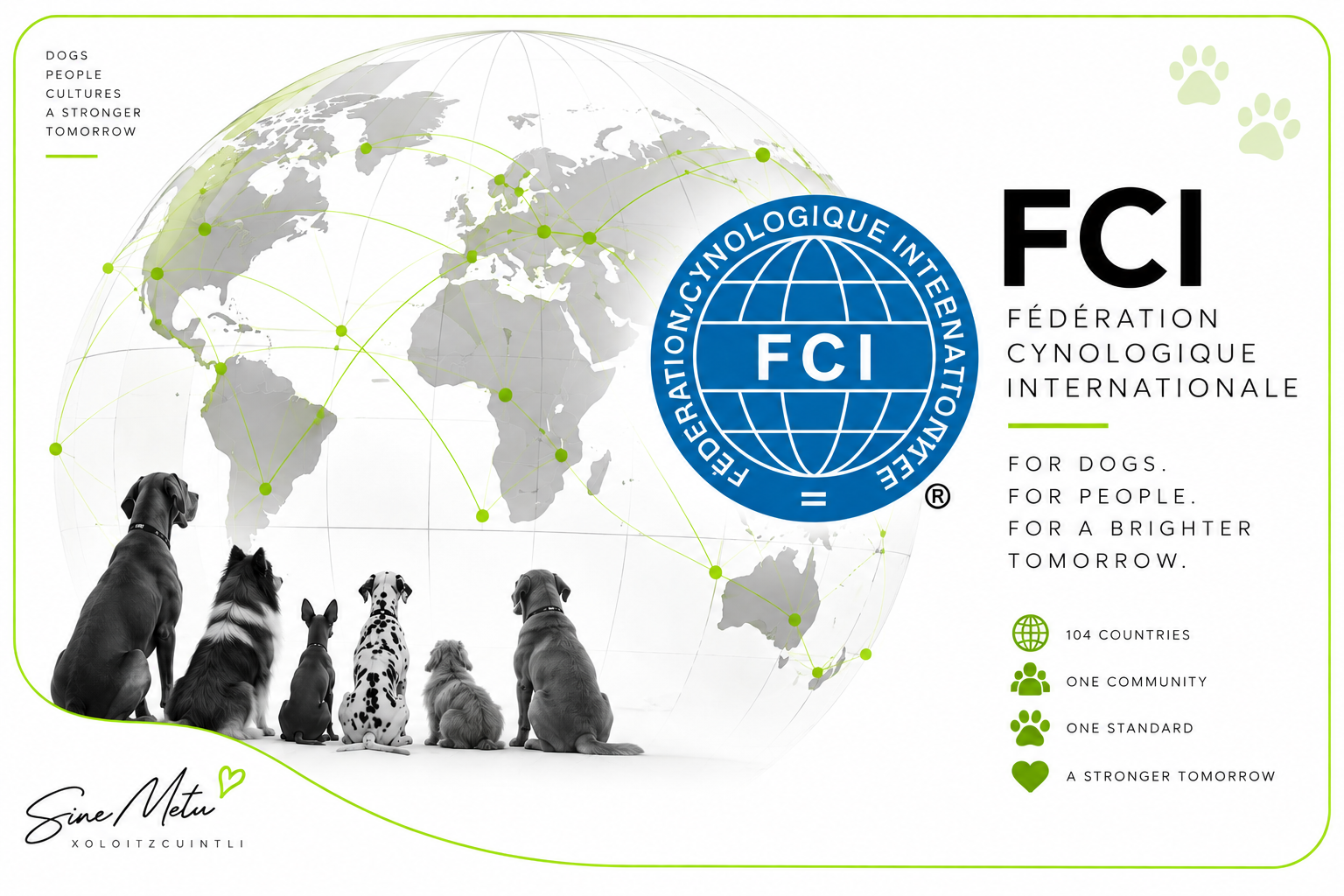
FCI is an international federation of national canine organisations.
It is important to understand this distinction.
FCI is not one giant kennel club that directly registers every dog in the world.
Instead, FCI brings together national canine organisations from different countries into one international system.
Each national organisation manages its own national canine activities, including its own studbooks and pedigrees, while FCI provides the international framework through which pedigrees, judges, breed standards, titles and many canine activities can be mutually recognised.
Today, FCI describes itself as the World Canine Organisation and states that it has 101 members and contract partners, with one member per country.
The history of FCI goes back more than a century.
The Fédération Cynologique Internationale was founded on:
22 May 1911.
Its original purpose was to promote and protect cynology and purebred dogs by whatever means it considered necessary.
The organisation was founded by five European countries:
These founding organisations were already involved in organised canine activities and pedigree dog systems in their respective countries.
The creation of FCI was an important step toward international cooperation.
Instead of every national organisation operating completely independently, the founding members created a framework through which the world of pedigree dogs could become more internationally connected.
The early history of FCI was interrupted by the First World War.
The federation disappeared during the conflict.
After the war, the organisation was recreated in 1921 by two of its original founding organisations:
New articles of association were adopted on 10 April 1921.
Later, on 5 March 1968, FCI obtained legal personality by decree.
The fact that the organisation survived, was recreated and continued developing after such a major interruption is an important part of its history.
Today, FCI represents an international canine system that has existed for more than a century.
Dog breeding developed nationally long before there was a truly international canine system.
Different countries had their own:
As international travel and dog showing developed, breeders increasingly imported dogs from other countries.
A dog could be bred in one country, registered in another and shown in a third.
This created a practical problem:
How could different national systems recognise one another?
An international framework became increasingly important.
FCI helped create a structure in which national canine organisations could cooperate while maintaining their own national systems.
More than a century after its foundation, FCI has developed into a worldwide federation.
According to the current FCI presentation, the organisation includes:
101 members and contract partners
with:
one member per country.
The FCI system is divided into three geographical sections:
This structure allows national canine organisations from very different regions to participate in one international system.
Ukraine is one of the FCI member countries, represented by the Ukrainian Kennel Union (UKU/KSU).
Yes — and this is not simply a marketing description created by breeders.
FCI itself uses the title:
“FCI: the largest canine organisation of the world.”
The scale of the organisation is reflected in its international network.
FCI currently lists 101 members and contract partners, representing countries across Europe, the Americas and Caribbean, and Asia, Africa and Oceania.
However, there is an important distinction.
FCI does not publish a single worldwide database containing every individual dog or every individual breeder registered within all member countries.
Each national canine organisation maintains its own national registration and pedigree system.
Therefore, it would be incorrect to say that “FCI has X million registered dogs” unless a specific official source provides such a number.
FCI's strength is not that it owns one enormous central dog registry.
Its strength is the international network and mutual recognition system connecting national canine organisations.
This is one of the most interesting facts about FCI.
The current FCI system recognises:
FCI states that each breed is considered the “property” of a specific country.
This concept is important.
FCI does not simply create a breed standard independently for every breed.
Instead, the country considered the breed's country of origin or ownership is responsible for developing the breed standard together with the relevant FCI commissions.
FCI then translates, updates and publishes the standards in its official working languages.
A breed standard is essentially the official description of the ideal representative of a breed.
It describes characteristics such as:
The standard provides the reference against which dogs are evaluated.
FCI specifically states that its breed standards are the reference for judges at shows held in FCI member countries and also for breeders attempting to produce high-quality dogs.
This is one of the most important reasons why the FCI system matters to breeders.
A breeder is not simply breeding a dog that looks attractive.
The breeder is working within the definition of the breed.
The standards originate with the countries associated with the respective breeds.
FCI explains that the “owner” countries write the standards in cooperation with the:
FCI then handles translation, updating and publication of the standards in its four official working languages:
This creates an international reference point for breeders and judges.
A serious breeder needs to understand what the breed is supposed to be.
The breed standard provides a framework for evaluating:
This does not mean that every dog will be identical.
No responsible breeder can produce a litter in which every puppy is a perfect copy of the standard.
Breeding is biological, and genetics always involves variation.
The purpose of the standard is to define the target.
The breeder's responsibility is to make thoughtful breeding decisions that move the next generation toward healthy, stable and correct representatives of the breed.
One of the most common misunderstandings about FCI is that FCI itself issues every pedigree.
It does not.
FCI explicitly states:
It is not a registry and does not issue pedigrees.
Instead, the national canine organisations issue their own pedigrees.
For example:
The national organisation maintains its national registration system.
FCI provides the international framework through which these systems interact and pedigrees are mutually recognised.
Imagine a puppy born in Ukraine.
The puppy is registered through the Ukrainian national canine organisation.
The breeder receives the appropriate registration document.
If the puppy is later exported to Spain, France, Germany or another country, the relevant international documentation allows the dog's pedigree and ownership information to be transferred into the new national system according to that country's rules.
The FCI framework makes international movement of pedigree dogs much more structured.
Without such international cooperation, every national system would effectively operate in isolation.
One of the most important functions of FCI is mutual recognition.
FCI states that its members mutually recognise:
This means that a dog registered through one FCI national organisation can participate in the international FCI system under the applicable rules of another member country.
The same principle applies to judges.
A judge qualified and recognised within the FCI system can be authorised to judge international events in other FCI member countries according to FCI rules.
This creates a genuinely international canine environment.
FCI is deeply connected with international dog shows.
Its members and contract partners conduct international events where dogs can compete for internationally recognised awards.
These include:
Certificat d'Aptitude au Championnat International de Beauté
The CACIB is associated with the FCI international beauty championship system.
There are also international awards for different canine disciplines, including:
FCI processes and homologates the results of these international competitions.
FCI homologates a range of international championship titles.
Depending on the discipline, dogs can obtain international titles in areas such as:
This is another reason FCI is important internationally.
A dog does not simply win a local title.
Under the appropriate FCI system, international achievements can become part of a recognised international championship record.
One of the most prestigious events connected with the organisation is the:
FCI World Dog Show.
It brings together exhibitors, breeders, judges and dogs from many countries.
The event rotates between countries.
For example, the FCI announced:
The 2026 FCI World Dog Show is scheduled in Italy as part of the organisation's international programme.
The World Dog Show represents one of the clearest examples of how international the FCI system has become.
FCI also plays an important role in international kennel-name registration.
A breeder can request international registration of a kennel name through their national canine organisation.
This is extremely important for breeders.
A kennel name is not simply a marketing brand.
It becomes part of the registered identity of dogs bred under that kennel.
The FCI maintains an international kennel-name system to help prevent conflicting or confusing kennel names between countries.
For a breeder building a serious breeding programme, international kennel-name registration is therefore an important part of establishing a recognised identity.
FCI is not only about dog shows.
Breeding and dog welfare are important parts of the organisation's work.
FCI has a dedicated Scientific Commission.
The commission consists of six members elected by the FCI General Assembly and works on scientific questions related to breeding and breeds.
Its responsibilities include:
This is an important part of the modern FCI system.
Responsible breeding cannot be based only on appearance.
It also has to consider health, genetics, reproduction, welfare and the long-term future of breeds.
Modern dog breeding increasingly involves genetic science.
FCI has published material addressing:
The FCI Scientific Commission specifically works on scientific issues that affect breeding and the future of pedigree dogs.
In 2025, FCI published material concerning the use and limitations of genomic tools for sustainable breed management and the relationship between breeding systems, health and welfare.
This demonstrates how the organisation's approach has developed beyond traditional pedigree documentation.
The health of pedigree dogs has become one of the major topics in modern canine breeding.
FCI provides scientific and breeding guidance concerning subjects such as:
The Scientific Commission maintains specific materials concerning official hip dysplasia screening and hip/elbow dysplasia certification.
The purpose is not to create one universal health test for every breed.
Different breeds have different genetic and anatomical risks.
Instead, FCI provides an international framework and scientific resources that can support responsible breeding decisions.
FCI also has a formal process for the international recognition of new breeds.
The Scientific Commission participates in this process.
FCI distinguishes between:
The process considers factors including:
FCI publishes a list of breeds recognised on a provisional basis as well as its definitive breed nomenclature.
This is important because FCI recognition is not simply a matter of submitting photographs of an unusual dog.
International breed recognition is a formal process.
The current FCI figure is:
364 recognised breeds.
The official nomenclature assigns each breed a number.
The list is continuously updated as breeds receive recognition and as administrative changes occur.
Some breeds are provisionally recognised, while others have definitive recognition.
This distinction is important.
A breed can enter the FCI system provisionally before receiving definitive international recognition.
The Xoloitzcuintli is one of the breeds recognised by FCI.
For breeders working with the breed, this means that the Xoloitzcuintli exists within a defined international framework that includes:
For a breeder, this provides something very important:
a common international reference for what the breed is.
A Xoloitzcuintli should not become a completely different breed depending on which country you visit.
The international standard provides continuity.
FCI organises recognised breeds into ten groups.
These groups reflect the historical and functional relationships between breeds.
The system includes categories such as:
The classification provides an international structure for shows, judging and breed organisation.
The international judging system is another major part of FCI.
FCI maintains internationally recognised judges who can officiate at international events under FCI rules.
FCI maintains international judge directories and regulates the framework under which judges are qualified and recognised.
This matters because judging must be based on a common reference.
If a dog receives an international result in France, Germany, Italy, Poland or Spain, the judge is working within the same broader FCI framework.
That creates consistency across borders.
An important question is:
What about the British Kennel Club?
The Kennel Club (UK) is not an FCI member.
The UK has its own national system.
However, FCI and the Kennel Club have maintained formal cooperation.
FCI's records include a long-standing cooperation agreement between the two organisations. The relationship includes areas such as mutual recognition of judges, breed standards and cooperation concerning pedigrees and canine activities.
In 2017, FCI and the Kennel Club signed a revised agreement concerning mutual recognition of dog show judges.
The relationship is therefore an excellent example of something important:
FCI is not the only major canine organisation in the world.
There are important national systems outside FCI, and FCI cooperates with some of them.
The American Kennel Club (AKC) is also not an FCI member.
The United States has its own national registration and dog-show system.
Nevertheless, FCI and AKC have maintained communication and cooperation.
FCI's own annual reporting has described communication with organisations including:
The topics have included responsible dog breeding, pedigree recognition, judges and dog sports.
The AKC itself has also described communication and cooperation with FCI concerning subjects including judging, dog health, legislation, international registries and responsible breeding.
This is important because it demonstrates that the international dog world is larger than any one organisation.
The Canadian Kennel Club (CKC) is another major national canine organisation outside the FCI membership structure.
FCI's own FAQ directs people with questions concerning dogs exported to the United States, England or Canada to the respective national organisations:
This reflects the practical division between international FCI coordination and national registration systems.
This is an important point for anyone researching pedigree dogs.
FCI is extremely important internationally, but it is not the only canine organisation in existence.
Different countries have their own systems.
Some are members of FCI.
Others are independent but may cooperate with FCI or other organisations.
For example:
These organisations can cooperate, recognise each other's documentation in certain circumstances and maintain formal agreements.
Therefore, saying that “FCI is the only organisation that matters” would be inaccurate.
A better description is:
FCI is the world's largest international federation of national canine organisations and one of the most influential international authorities in the world of pedigree dogs.
There are several reasons.
FCI was founded in 1911.
It has existed through enormous changes in international dog breeding and organised canine sport.
FCI currently includes 101 members and contract partners across the world.
FCI creates a framework for mutual recognition of pedigrees and judges among its members.
FCI recognises 364 breeds and publishes the standards used as references for judges and breeders.
FCI has a Scientific Commission dealing with genetics, breeding, health, welfare and scientific developments affecting breeds.
FCI governs or coordinates international titles and competitions across many canine disciplines.
FCI provides an international kennel-name registration system through national canine organisations.
Together, these factors explain why FCI has such a significant position in the international pedigree dog world.
FCI's activities are much broader than dog shows.
The FCI Secretariat, for example, works on:
FCI therefore acts as an international coordinating body.
Understanding what FCI does not do is equally important.
FCI states that it:
Those functions are handled by the relevant national canine organisations.
This distinction prevents a great deal of confusion.
When someone asks:
“Can I contact FCI to get my dog's pedigree?”
the answer is normally no.
You should contact the national canine organisation that issued or manages the pedigree.
The FCI system is based on a simple but powerful principle:
one national organisation represents each country within the FCI structure.
That national organisation operates the country's pedigree and canine system.
FCI then provides international coordination.
This means that a breeder in Ukraine and a breeder in France may work under different national administrative procedures, but their dogs exist within a common international framework.
For a breeder, FCI provides a framework in which breeding is connected to:
It creates continuity between generations.
A breeder can look at a pedigree and trace ancestors across countries.
A judge can evaluate a dog according to an internationally recognised breed standard.
An owner can move a dog between countries while maintaining its pedigree identity, subject to the rules of the relevant national organisations.
That international continuity is one of the greatest strengths of the FCI system.
The world of dog breeding is changing.
Modern breeders face questions that previous generations could not answer with traditional knowledge alone.
These include:
FCI is increasingly addressing these questions through its Scientific Commission and breeding-related work.
The future of responsible breeding will require both:
respect for breed heritage
and
modern scientific knowledge.
The two should not be treated as opposites.
For us as breeders, choosing a canine system was never about simply choosing a logo or a piece of paper.
When we began developing our breeding programme, the decision was straightforward.
We wanted to work within an international system that had:
The FCI system provided that framework.
It was not a decision based on searching for the easiest system.
It was a decision based on choosing a system with an established international structure and a clear connection between national breeding organisations and the international world of pedigree dogs.
Our kennel therefore operates within the FCI system through the Ukrainian Kennel Union.
For someone looking for a puppy, FCI recognition can provide an additional layer of structure.
It means that the breeder's dogs can exist within an established pedigree system rather than being documented only through an informal private registry.
However, FCI registration alone does not automatically mean that every breeder is responsible or that every puppy is healthy.
A buyer should still investigate:
A recognised system is a framework.
The breeder still has a responsibility to use that framework properly.
This distinction is extremely important.
A pedigree does not guarantee that a dog will become a champion.
An FCI registration does not guarantee that a breeder makes every breeding decision correctly.
A breed standard does not eliminate genetic disease.
A kennel name does not automatically make someone a responsible breeder.
What FCI provides is the international structure.
What the breeder does with that structure is a matter of professional responsibility.
Dogs increasingly cross borders.
A puppy born in Ukraine may live in Spain.
A dog bred in Germany may later live in France.
A champion from Italy may be shown in Poland.
A breeding dog may have ancestors from several countries.
International recognition makes this movement possible within a structured pedigree system.
Instead of each country treating every foreign pedigree as an unknown document, the FCI framework provides mechanisms for recognition and cooperation.
This is one of the reasons the system has become so important to modern pedigree dog breeding.
If we had to explain FCI in one sentence:
FCI is the world's largest international federation of national canine organisations, creating a common framework for pedigree dogs, breed standards, judges, international titles, kennel names, breeding and canine sport.
CategoryFCIFull nameFédération Cynologique InternationaleCommon descriptionWorld Canine OrganisationFounded22 May 1911Founding countriesGermany, Austria, Belgium, France, NetherlandsCurrent members & contract partners101Recognised breeds364Structure3 geographical sectionsMain roleInternational federation of national canine organisationsPedigreesIssued by national canine organisationsBreed standardsDeveloped with breed-owner countries and FCI commissionsInternational kennel namesRegistered through national canine organisationsInternational titlesHomologated by FCIInternational judgesCoordinated/recognised through FCI systemScientific workFCI Scientific CommissionWorld eventFCI World Dog Show
The figures above reflect the current information published by FCI and may change as the organisation develops.
FCI is much more than an abbreviation printed on a pedigree.
It represents more than a century of international cooperation in the world of pedigree dogs.
Founded in 1911 by five European canine organisations, FCI has grown into a worldwide federation connecting national canine organisations across three geographical sections.
Today, it recognises 364 breeds and brings together 101 members and contract partners.
It provides an international framework for breed standards, pedigree recognition, judges, kennel names, dog shows, working disciplines, international titles and scientific approaches to breeding and canine welfare.
At the same time, FCI is not a single global dog registry and does not issue every individual pedigree itself. Those responsibilities remain with national canine organisations.
That structure is precisely what makes the system work.
National organisations preserve and administer their national canine systems.
FCI connects them internationally.
For breeders, this creates continuity.
For judges, it creates common standards.
For owners, it creates international recognition.
For breeds, it creates an organised framework for preserving their identity while allowing modern scientific knowledge to influence their future.
And for us, as breeders, this international structure is one of the reasons we chose to build our breeding programme within the FCI system.
For us, pedigree is not simply a document. It is a connection between generations, a breed standard is a responsibility, and international recognition is part of preserving the identity and future of the breed.

Is a mono-breed Miniature Xolo kennel.
We know everything about the Xolo breeding and even more.
We choose only the best Xolo bloodlines in the world for the breeding purpose in our kennel.
Our graduates live in more than 15 countries in Europe, the USA and Canada.
All our breeding dogs get tested for genetic diseases and are in excellent health condition.


